

Latest [Aug 18, 2026] Fortinet NSE5_FWF_AD-7.6 Exam Practice Test To Gain Brilliante Result
Take a Leap Forward in Your Career by Earning Fortinet NSE5_FWF_AD-7.6
NEW QUESTION # 11
Which two threats on wireless networks are detected by WIDS? (Choose two.)
- A. WPA2 authentication vulnerabilities
- B. Brute-force dictionary attacks
- C. Unauthorized wireless connection
- D. Rogue access points
Answer: B,D
Explanation:
Brute-force dictionary attacks (Asleap)
WIDS includes detection for Asleap attacks - tools that perform brute-force dictionary attacks against LEAP authentication - so you'll see an intrusion alert whenever such a dictionary attack is observed on your air-side traffic Rogue access points WIDS continuously scans for and flags any unauthorized (rogue) APs broadcasting within your RF environment, alerting you the moment a rogue SSID or BSSID appears.
NEW QUESTION # 12
Refer to the exhibit. The wireless station with MAC address 5a:29:94:87:f7:b8 has made multiple attempts to connect to the CORP_DATA SSID. Despite client-association-failure event logs, the wireless station connects on the final attempt.
Why did the wireless station fail to connect initially?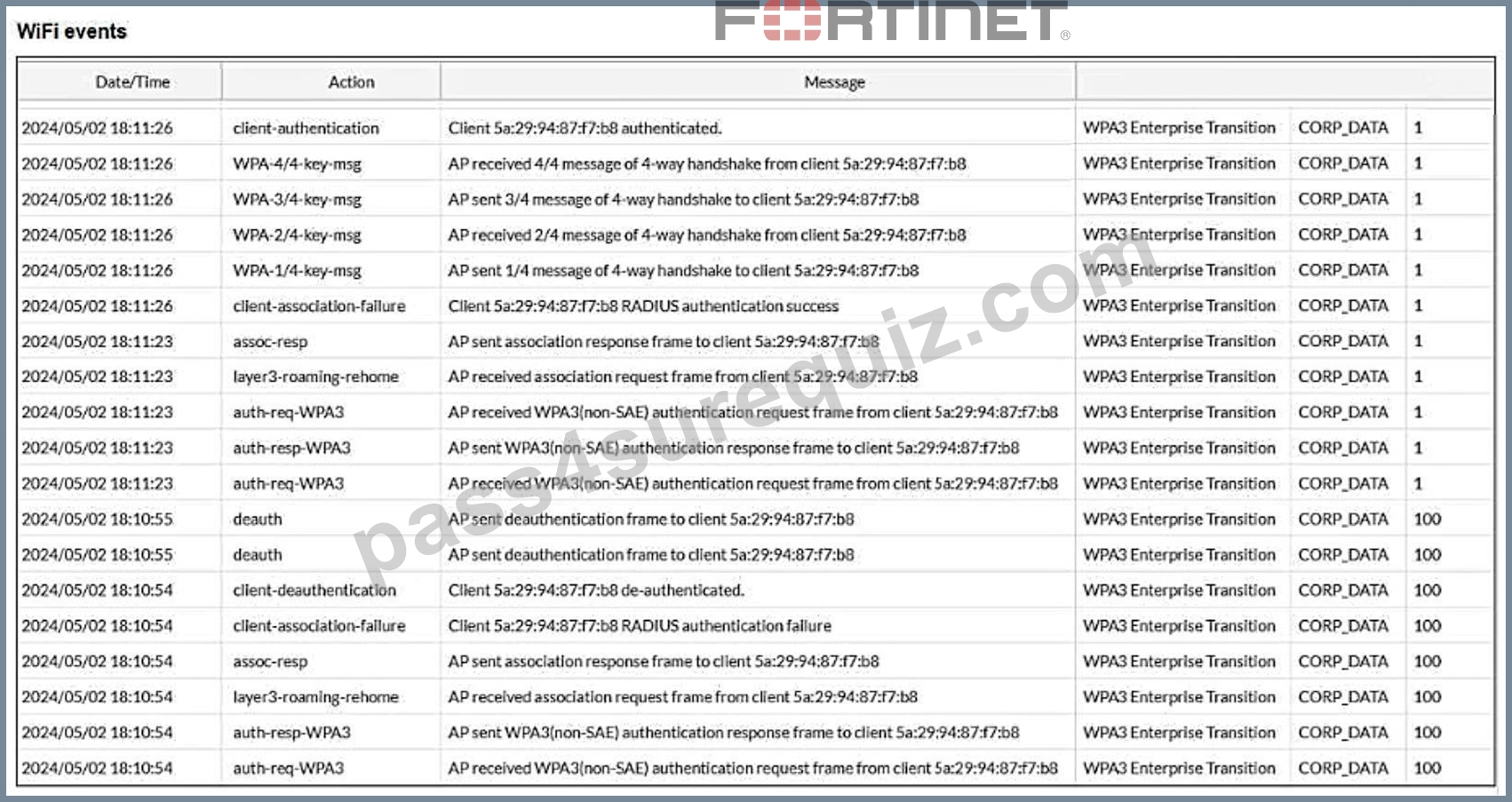
- A. The wireless station connected to SSID but failed RADIUS authentication.
- B. The wireless controller unauthenticated the wireless station to prevent evil twin attacks.
- C. The wireless station used invalid credentials on the failed attempt.
- D. The wireless station was incompatible with the 5 GHz radio band.
Answer: A
Explanation:
The event log shows a client-association-failure with the message "RADIUS authentication failure" on the first attempts, indicating the supplicant reached the AP but the RADIUS server rejected the credentials. On the final try, valid credentials were supplied and the 4-way handshake completed successfully.
NEW QUESTION # 13
Which two statements are correct about FortiAP and rogue APs? (Choose two.)
- A. FortiAP suppresses detected rogue APs manually.
- B. FortiAP scans rogue APs in the background while broadcasting SSIDs.
- C. FortiAP detects rogue APs on dedicated monitoring radios.
- D. FortiAP offers automatic suppression of rogue APs when broadcasting SSIDs.
Answer: B,C
Explanation:
Background scanning while serving clients
Each FortiAP radio can periodically switch into monitoring mode for a few milliseconds to scan for rogue APs, then switch back to serve its SSIDs, allowing continual SSID broadcasting and client service while still detecting rogues in the background.
Dedicated-monitor radio detection
In dual-radio FortiAP models you can put one radio into "Dedicated Monitor" mode. That radio never transmits SSIDs, and instead continuously listens on all channels to detect and locate rogue Aps.
NEW QUESTION # 14
Refer to the exhibit of a wireless client performance monitor.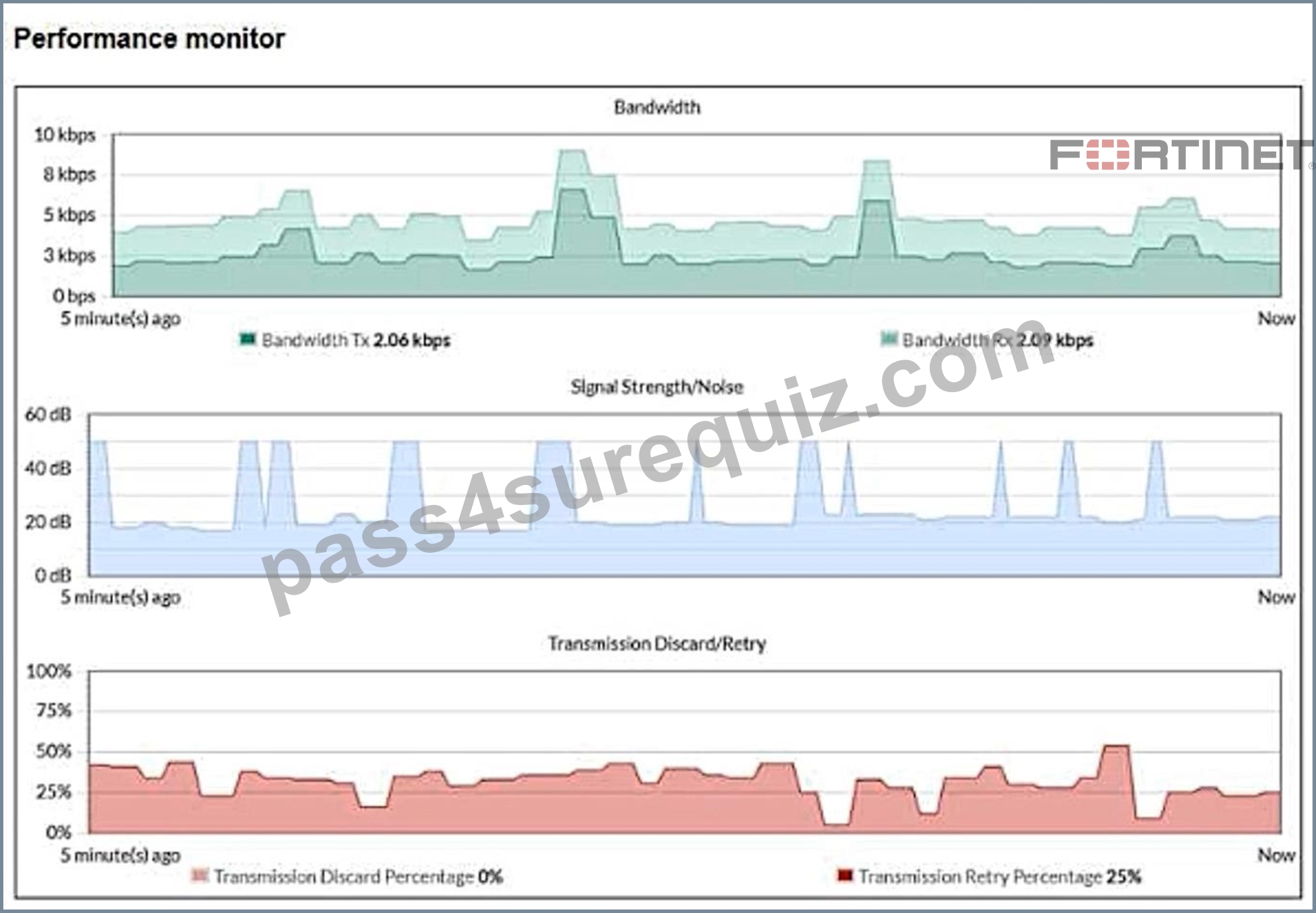
Which performance metric is abnormal for this wireless client?
- A. The wireless client has been transmitting traffic with all performance metrics within the normal levels.
- B. The wireless client has been dropping half of the packets transmitted within the last 5 minutes.
- C. The wireless client has been switching between available wireless bands within the last 5 minutes.
- D. The wireless client has been experiencing high background noise within the last 5 minutes.
Answer: B
Explanation:
A transmission retry rate of around 25 % (one retry in four) is far above normal - indicating roughly that a quarter of all frames must be resent (and many of those may ultimately be dropped), which is an abnormal performance metric for a healthy client connection.
NEW QUESTION # 15
You plan to deploy a wireless network at various remote sites with no on-site IT available. The remote sites must have access points to broadcast the wireless networks. You can manage the access points using any Fortinet control and management option.
Which two items must you consider in addition to deploying the wireless network and enforcing Fortinet UTM on all wireless traffic? (Choose two.)
- A. To install the access points designed to provide Fortinet UTM services.
- B. To deploy the SSIDs in bridge mode bridged to the access points subnet.
- C. To manage the access points by FortiLAN Cloud and create a tunnel between access points.
- D. To power the access points with a UTM-capable FortiSwitch device.
Answer: A,B
Explanation:
To install the access points designed to provide Fortinet UTM services
Only UTM-capable FortiAP models can enforce security profiles locally on wireless traffic, so you must select FortiAP-U/S series units if you want UTM at the edge.
To deploy the SSIDs in bridge mode bridged to the access points subnet
Local UTM on the AP only applies to "local-bridge" SSIDs. Configuring your SSIDs in bridge mode is required for those UTM profiles to actually inspect the tunneled wireless traffic.
NEW QUESTION # 16
Refer to the exhibits. FortiGate is pushing the POST parameters shown in the exhibit to the external captive portal server. The wireless client redirection fails because certificate validation occurred while loading the web page.
The wireless client browser uses the FortiGate self-signed certificate to access secured web pages. The SSID on FortiGate has the captive portal setting enabled.
What could cause the certification validation error on the wireless client?
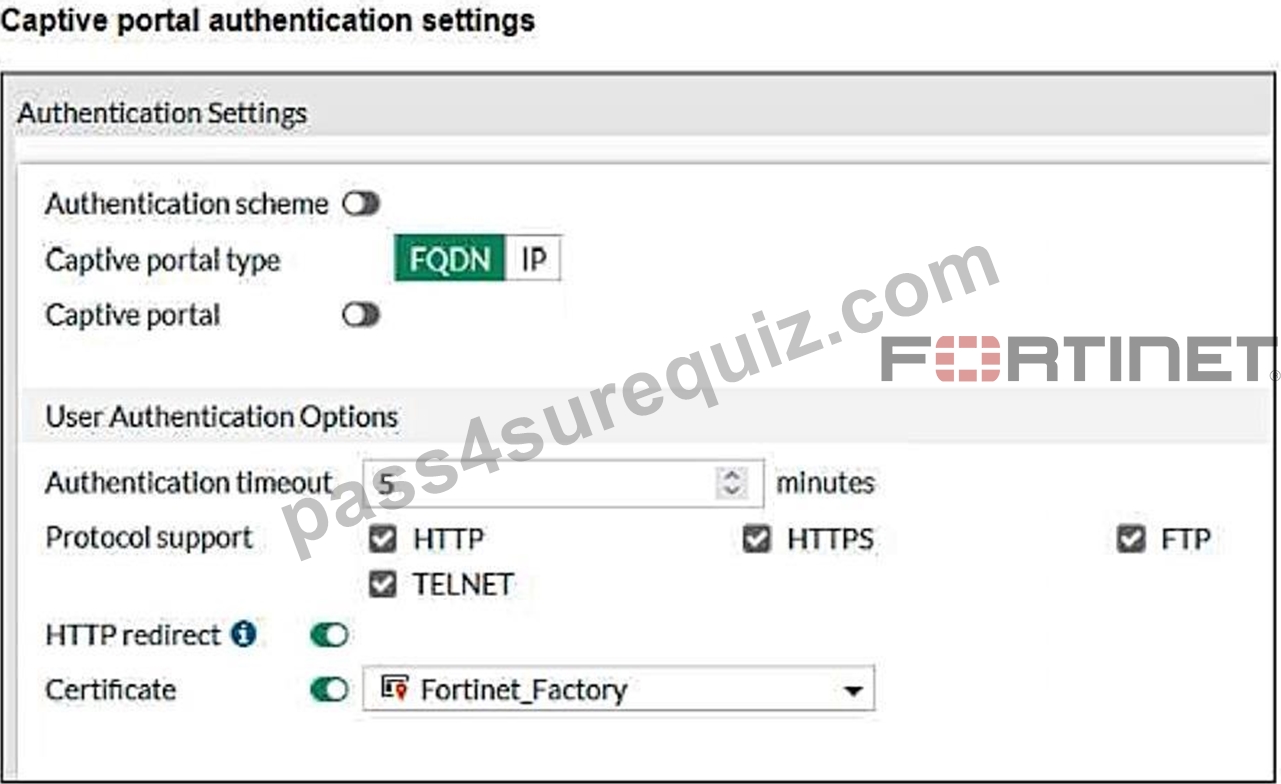
- A. The captive portal setting in the authentication setting is set to use FQDN as the captive portal type.
- B. The FortiGate IP address in the POST parameters is using a numerical IP address.
- C. The used credential is not embedded in the captive portal parameters.
- D. The external server address is not the FQDN address.
Answer: A
Explanation:
Because you've configured the portal to use an FQDN but the redirect URL (and certificate) is based on an IP address, the browser sees a host-name mismatch when validating the FortiGate's self-signed cert. Aligning the captive-portal type and the redirect URL (both via FQDN or both via IP) resolves the validation error.
NEW QUESTION # 17
When enabling a Security Fabric connection on a FortiGate interface to manage FortiAP devices, which two types of CAPWAP communication channels are established between FortiGate and the FortiAP devices? (Choose two.)
- A. Control channels
- B. FortiLink channels
- C. Security channels
- D. Data channels
Answer: A,D
Explanation:
FortiAPs and the FortiGate establish two distinct CAPWAP tunnels when you enable the Security Fabric Connection:
- Control channels carry management and configuration traffic (encrypted by DTLS by default) between the FortiGate and each FortiA
- Data channels carry user-plane (client) traffic across the CAPWAP tunnel, separate from the control path
NEW QUESTION # 18
Refer to the exhibit. Which traffic is crucial between the FortiAP devices and FortiGate to support AP configuration updates and management services?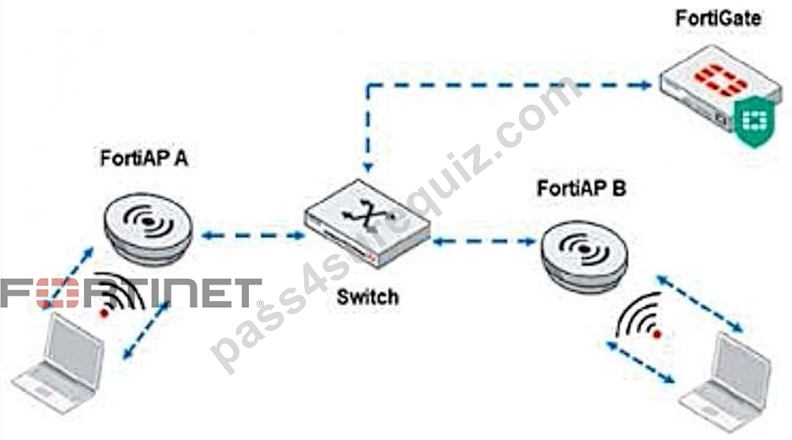
- A. License management traffic
- B. Data traffic
- C. Layer 2 traffic
- D. Control traffic
Answer: D
Explanation:
The CAPWAP control channel between each FortiAP and the FortiGate carries all configuration pushes, keep-alive heartbeats, and management operations, making it essential for AP provisioning and ongoing management.
NEW QUESTION # 19
Employees at the remote office reported speed issues with the wireless network. Dual-band FortiAP devices have been correctly deployed throughout the office to ensure coverage and optimal performance. However, employees have noticed that the wireless stations consistently connect to the 2.4 GHz network but not the 5 GHz network.
What must IT administrators perform to troubleshoot the issue?
- A. Review if FortiAP resources are not experiencing high CPU or memory usage.
- B. Verify that the allocated frequency channel on FortiAP is not exhausted.
- C. Confirm whether internet speed limits are preventing access to high speed by wireless stations.
- D. Disable the 2.4 GHz radio to force the wireless stations to connect.
Answer: B
NEW QUESTION # 20
A company requires a secure wireless network to span several adjacent buildings. Employees need seamless roaming access across buildings, floors, and, potentially, outdoor areas. FortiAP devices will be used.
Which deployment is the most scalable, manageable, and cost-effective in this scenario?
- A. Configure FortiGuard-capable FortiAP devices to broadcast the corporate SSID without being managed by FortiGate in the main building.
- B. Implement a wireless mesh design to allow FortiAP devices to use neighboring FortiAP devices to connect with FortiGate in the main building.
- C. Install FortiWiFi with a cellular modem in the buildings and areas where no wireless signal reaches from the main building.
- D. Deploy a WAN connection on each building to allow FortiAP devices to communicate with FortiGate in the main building.
Answer: B
NEW QUESTION # 21
Which two management services support connecting FortiAPs to the FortiPresence cloud?
(Choose two.)
- A. FortiLAN Cloud
- B. FortiGate
- C. FortiSwitch Manager
- D. FortiSASE
Answer: A,B
Explanation:
When you register FortiAPs with FortiPresence, you can manage the AP-to-FortiPresence link directly from the FortiGate's AP Manager, which pushes the registration info to the cloud.
Alternatively, if you're using FortiLAN Cloud to manage your FortiAP fleet, it also includes built-in support for FortiPresence registration and analytics.
NEW QUESTION # 22
Refer to the exhibit. Why is Radio 3 used for the spectrum analysis?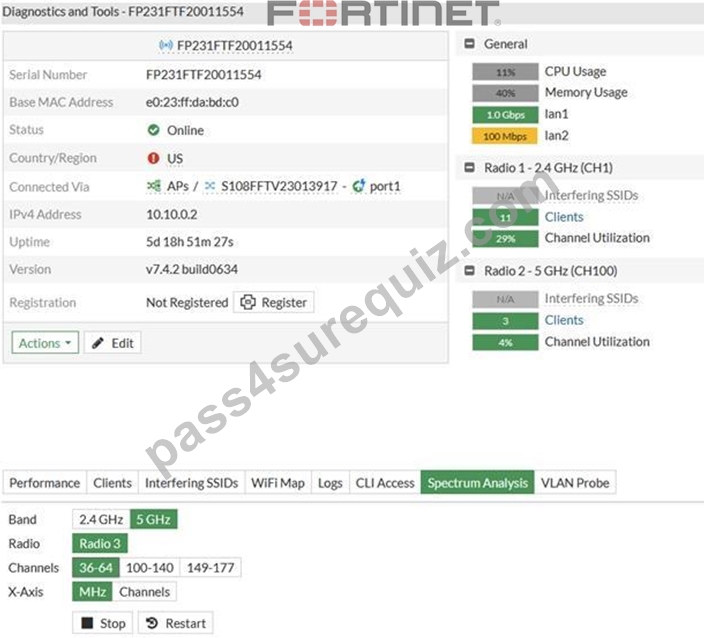
- A. Radio 3 is the configured dedicated monitoring radio for this FortiAP model.
- B. Radio 1 and Radio 2 are unavailable to run the spectrum analysis.
- C. Only Radio 3 is compatible with the selected band.
- D. The 5 GHz frequency band is available only on Radio 3.
Answer: A
NEW QUESTION # 23
A wireless station has reported several connection issues with FortiAP that have not been resolved using standard troubleshooting tools.
As a wireless network administrator, you are planning to perform additional advanced-level troubleshooting.
Which two steps must you take to analyze and troubleshoot the issue? (Choose two.)
- A. Collect low-level information on FortiAP power management.
- B. Capture the wireless station traffic in the air.
- C. Review event logs reporting wireless station activities.
- D. Create and assign a new FortiAP profile detected for troubleshooting.
Answer: B,C
Explanation:
Capture the wireless station traffic in the air
Putting a FortiAP into sniffer mode lets you grab 802.11 frames between the client and AP, revealing retries, authentication exchanges, and RF issues at the packet level.
Review event logs reporting wireless station activities (C)
The detailed wireless event logs on the FortiGate/FortiAP record each client's association, authentication, and error codes, providing a timeline of what's succeeding or failing during the connection process.
NEW QUESTION # 24
A FortiAP device is connected directly to a FortiGate interface.
What discovery method will be used to provision the FortiAP device?
- A. FortiAP discovers FortiGate by reviewing the vendor class value.
- B. FortiGate discovers the FortiAP IP address from DHCP option 138.
- C. FortiAP discovers FortiGate by connecting to FortiLAN Cloud to verify its management license.
- D. FortiGate discovers the FortiAP through the received broadcast packets.
Answer: D
NEW QUESTION # 25
A wireless station successfully connects to a wireless network and fails to communicate with other devices on the network or access the internet. As an administrator, what two pieces of information must you collect to troubleshoot the issue? (Choose two.)
- A. Check the wireless station signal status with FortiAP.
- B. Verify whether the DHCP scope has an available IP address to assign.
- C. Confirm that the wireless client is compatible with FortiAP technology.
- D. Monitor whether the wireless network is experiencing high-level noise or distortion.
Answer: A,B
NEW QUESTION # 26
An IT department must provide wireless security to employees connected over remote FortiAP devices who must access corporate resources at the main office.
Which action must the IT department take to enforce security policies for all wireless stations accessing corporate resources across all remote locations?
- A. Deploy further onsite IT personnel to these remote sites to enforce security inspection.
- B. Implement a teleworker topology to split traffic for further security inspection.
- C. Transfer local resources from corporate data centers to cloud services to offer access to remote users.
- D. Configure VPN tunnels to transport secured data between the main office and branch offices.
Answer: B
Explanation:
By using the teleworker mode on remote FortiAPs, all wireless client traffic is tunneled back to the central FortiGate, where security policies and inspections are uniformly applied before granting access to corporate resources.
NEW QUESTION # 27
......
Authentic Best resources for NSE5_FWF_AD-7.6 Online Practice Exam: https://actualanswers.pass4surequiz.com/NSE5_FWF_AD-7.6-exam-quiz.html