

Juniper JN0-664 Cert Guide PDF 100% Cover Real Exam Questions
Pass JN0-664 Exam - Real Questions and Answers
The JN0-664 exam consists of 65 multiple-choice questions, and candidates are given 120 minutes to complete the exam. JN0-664 exam is available in English and Japanese, and it can be taken at any Pearson VUE testing center worldwide.
NEW QUESTION # 28
Exhibit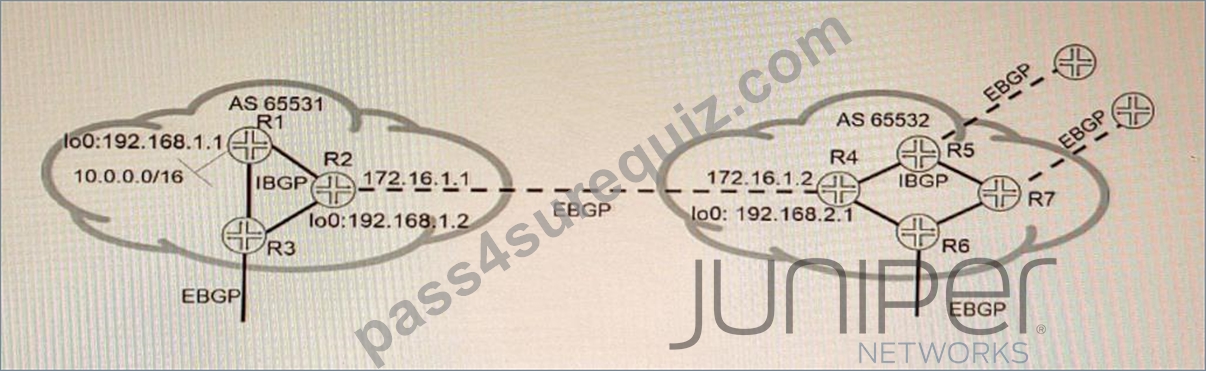
Referring to the exhibit, which three statements are correct about route 10 0 0.0/16 when using the default BGP advertisement rules'? (Choose three.)
- A. R1 will advertise 10.0.0.0/16 to R2 with 192 168 1 1 as the next hop.
- B. R2 will advertise 10.0.0.0/16 to R3 with 192.168.1 1 as the next hop
- C. R2 will advertise 10.0.0.0/16 to R4 with 172.16.1.1 as the next hop
- D. R4 will advertise 10 0.0 0/16 to R6 with 172.16 1 1 as the next hop
- E. R1 will prepend AS 65531 when advertising 10 0.0 0/16 to R2.
Answer: B,C,E
NEW QUESTION # 29 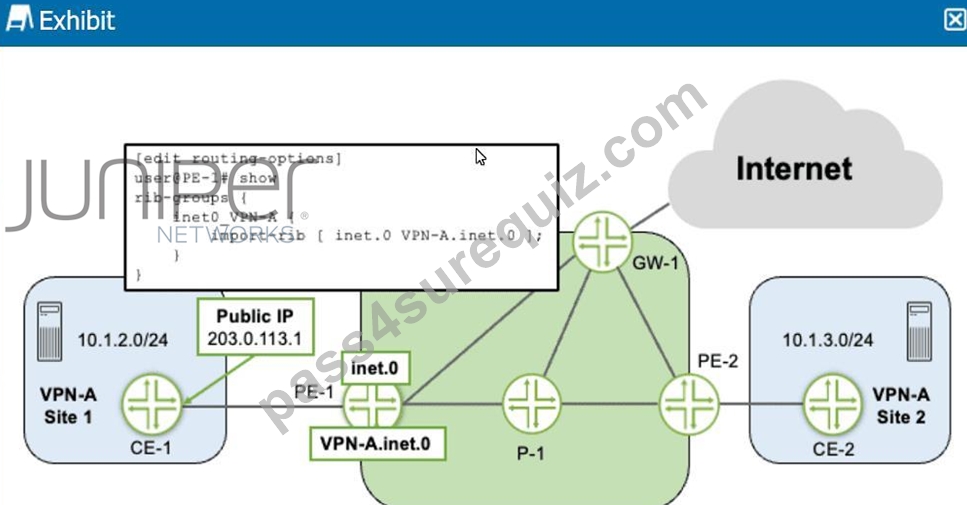
Click the Exhibit button.
Referring to the exhibit, you must provide VRF Internet access over a single connection for VPN-A Site 1, which connects to PE-1.
Which two statements are correct in this scenario? (Choose two.)
- A. You must use the RIB group to move a default route, which is learned through BGP, from the inet. o table to the VPN-A. inet. 0 table.
- B. You do not need to use the RIB group to move interface routes from the inet. o table to the VPN-A.
inet. 0 table. - C. You must use the RIB group to move interface routes from the inet . 0 table to the VPN-A. inet. 0 table.
- D. You do not need to use the RIB group default route, which is learned through BGP, from the inet. o table to the VPN-A. inet. 0 table.
Answer: A,B
Explanation:
In the provided exhibit, the configuration involves using a RIB (Routing Information Base) group to facilitate internet access for VPN-A Site 1 through PE-1. The goal is to provide VRF Internet access over a single connection.
1. **Understanding RIB Groups**:
- RIB groups allow for the import and export of routes between different routing tables.
- In this scenario, we have two RIBs: `inet.0` (the main routing table) and `VPN-A.inet.0` (the VRF-specific routing table).
2. **Statement Analysis**:
- **A. You must use the RIB group to move a default route, which is learned through BGP, from the inet.0 table to the VPN-A.inet.0 table.**
- Correct. To provide Internet access to VPN-A, the default route (0.0.0.0/0) learned via BGP in the `inet.0` table must be made available in the `VPN-A.inet.0` table. This is done using the RIB group to import the default route.
- **B. You do not need to use the RIB group to move interface routes from the inet.0 table to the VPN-A.inet.
0 table.**
- Correct. Interface routes (connected routes) are typically directly added to both the global and the VRF routing tables without needing a RIB group. These routes are known to the VRF because the interfaces are part of the VRF configuration.
- **C. You do not need to use the RIB group default route, which is learned through BGP, from the inet.0 table to the VPN-A.inet.0 table.**
- Incorrect. As discussed, the default route needs to be imported into the VRF's routing table using a RIB group to enable Internet access for the VRF.
- **D. You must use the RIB group to move interface routes from the inet.0 table to the VPN-A.inet.0 table.**
- Incorrect. Interface routes are directly associated with the VRF interfaces and are automatically known to the VRF routing table. There is no need to use a RIB group for these routes.
**Conclusion**:
The correct answers are:
**A. You must use the RIB group to move a default route, which is learned through BGP, from the inet.0 table to the VPN-A.inet.0 table.**
**B. You do not need to use the RIB group to move interface routes from the inet.0 table to the VPN-A.inet.0 table.**
**References**:
- Juniper Networks Documentation on RIB Groups: [RIB Groups Overview](https://www.juniper.net
/documentation/en_US/junos/topics/concept/rib-groups-overview.html)
- Junos OS VPNs Configuration Guide: [Junos VPNs Configuration](https://www.juniper.net/documentation
/en_US/junos/topics/concept/vpns-overview.html)
NEW QUESTION # 30
Exhibit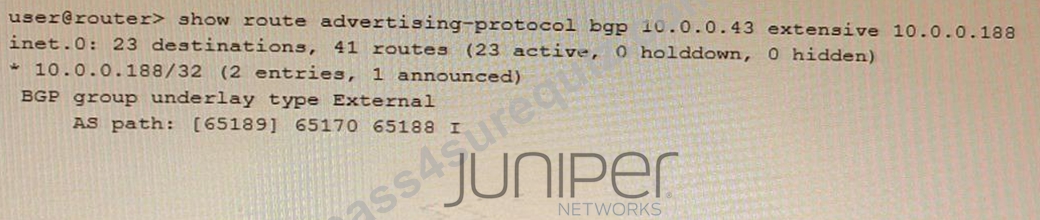
Referring to the exhibit, what do the brackets [ ] in the AS path identify?
- A. They identify that a BGP confederation is being used to ensure that there are no routing loops.
- B. They identify that the autonomous system number is incomplete and awaiting more information from the BGP protocol.
- C. They identify the local AS number associated with the AS path if configured on the router, or if AS path prepending is configured
- D. They identify an AS set, which are groups of AS numbers in which the order does not matter
Answer: D
Explanation:
The brackets [ ] in the AS path identify an AS set, which are groups of AS numbers in which the order does not matter. An AS set is used when BGP aggregates routes from different ASs into a single prefix. For example, if BGP aggregates routes 10.0.0.0/16 and 10.1.0.0/16 from AS 100 and AS 200, respectively, into a single prefix 10.0.0.0/15, then the AS path for this prefix will be [100 200]. An AS set reduces the length of the AS path and prevents routing loops.
NEW QUESTION # 31
Exhibit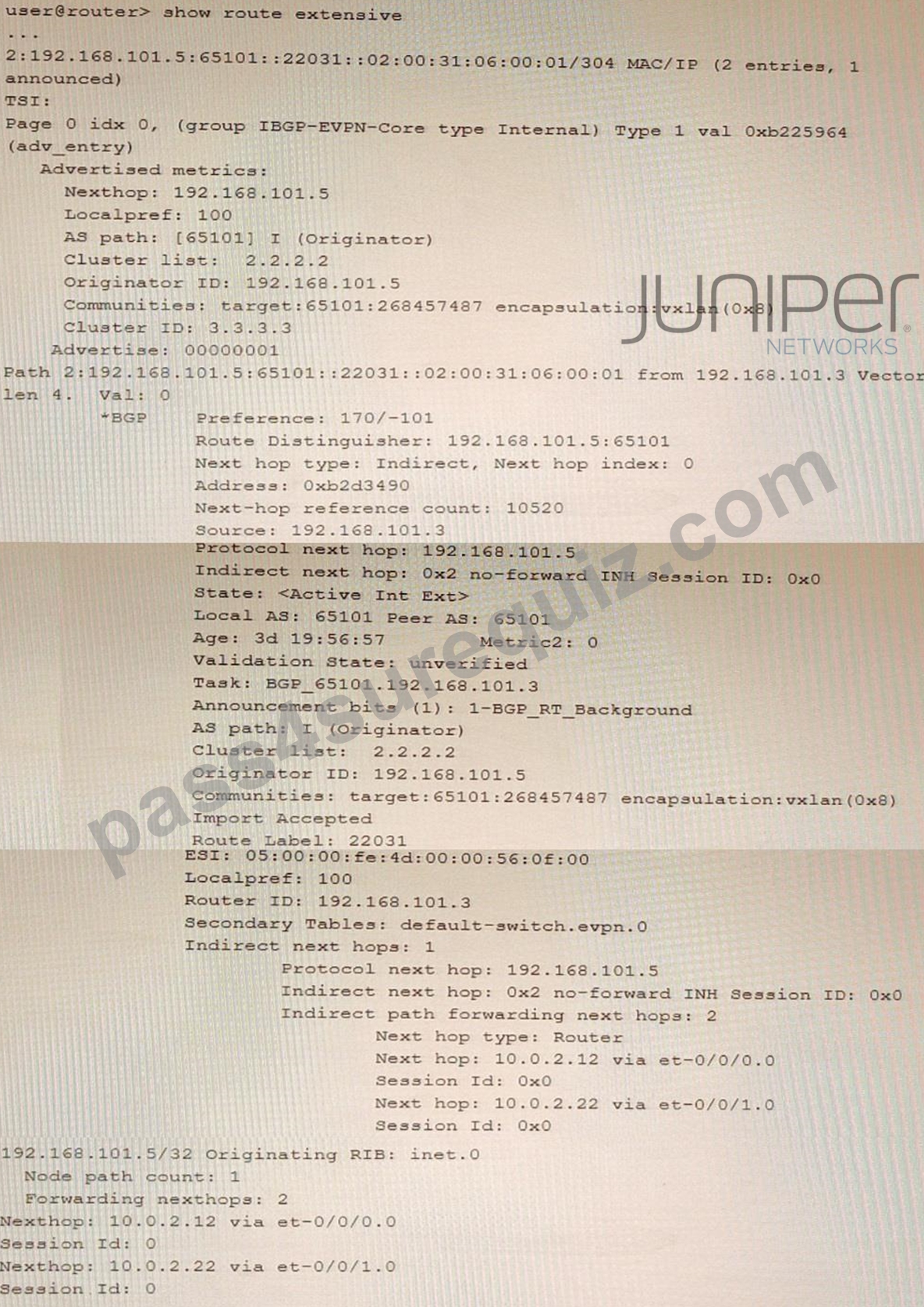
Referring to the exhibit, which two statements are true? (Choose two.)
- A. This route is learned through EBGP
- B. The device advertising this route into EVPN is 192.168.101.5.
- C. The devices advertising this route into EVPN are 10 0 2 12 and 10.0.2.22.
- D. This is an EVPN Type-2 route.
Answer: B,D
Explanation:
This is an EVPN Type-2 route, also called a MAC/IP advertisement route, that is used to advertise host IP and MAC address information to other VTEPs in an EVPN network. The route type field in the EVPN NLRI has a value of 2, indicating a Type-2 route. The device advertising this route into EVPN is 192.168.101.5, which is the IP address of the VTEP that learned the host information from the local CE device. This IP address is carried in the MPLS label field of the route as part of the VXLAN encapsulation.
NEW QUESTION # 32
Exhibit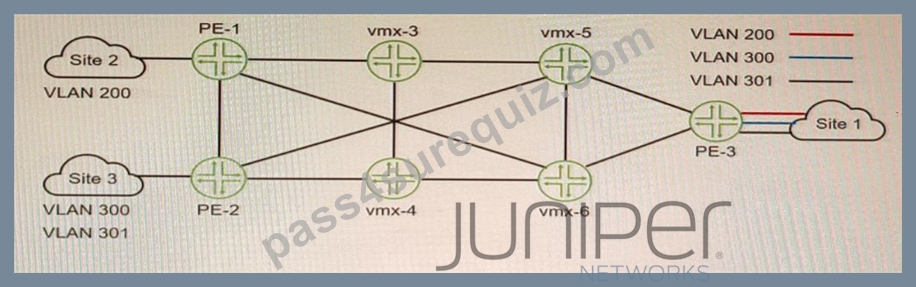
You want Site 1 to access three VLANs that are located in Site 2 and Site 3 The customer-facing interface on the PE-1 router is configured for Ethernet-VLAN encapsulation.
What is the minimum number of L2VPN routing instances to be configured to accomplish this task?
- A. 0
- B. 1
- C. 2
- D. 3
Answer: D
Explanation:
Explanation
To allow Site 1 to access three VLANs that are located in Site 2 and Site 3, you need to configure three L2VPN routing instances on PE-1, one for each VLAN. Each L2VPN routing instance will have a different VLAN ID and a different VNI for VXLAN encapsulation. Each L2VPN routing instance will also have a different vrf-target export value to identify which VPN routes belong to which VLAN. This way, PE-1 can forward traffic from Site 1 to Site 2 and Site 3 based on the VLAN tags and VNIs.
NEW QUESTION # 33
You have MAC addresses moving in your EVPN environment.
Referring to the exhibit, which two statements are correct about the sequence number? (Choose two.)
- A. It resolves conflicting MAC address ownership claims.
- B. It identifies MAC addresses that should be discarded.
- C. It helps the local PE to identify the latest advertisement.
- D. It is advertised using a Type 2 message.
Answer: A,C
NEW QUESTION # 34
Exhibit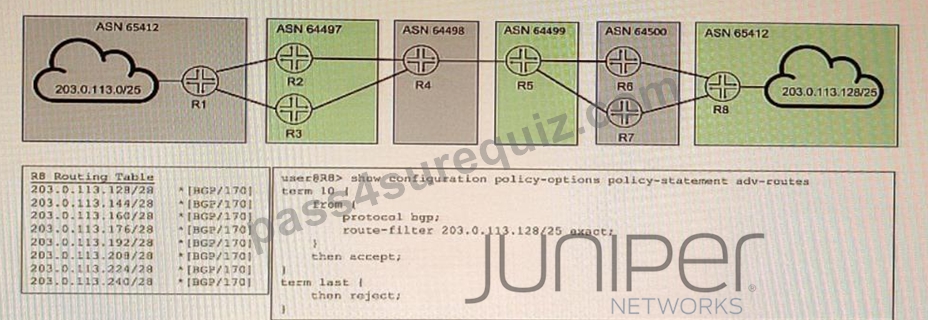
You are attempting to summarize routes from the 203.0.113.128/25 IP block on R8 to AS 64500. You implement the export policy shown in the exhibit and all routes from the routing table stop being advertised.
In this scenario, which two steps would you take to summarize the route in BGP? (Choose two.)
- A. Add the set protocols bgp family inet unicast add-path command to allow additional routes to the RIB tables. -
- B. Remove the from protocol bgp command from the export policy.
- C. Replace exact in the export policy with orlonger.
- D. Add the set routing-options static route 203.0.113.123/25 discard command.
Answer: C,D
Explanation:
To summarize routes from the 203.0.113.128/25 IP block on R8 to AS 64500, you need to do the following:
* Add the set routing-options static route 203.0.113.128/25 discard command. This creates a static route for the summary prefix and discards any traffic destined to it. This is necessary because BGP can only advertise routes that are present in the routing table.
* Replace exact in the export policy with orlonger. This allows R8 to match and advertise any route that is equal or more specific than the summary prefix. The exact term only matches routes that are exactly equal to the summary prefix, which is not present in the routing table.
NEW QUESTION # 35
Exhibit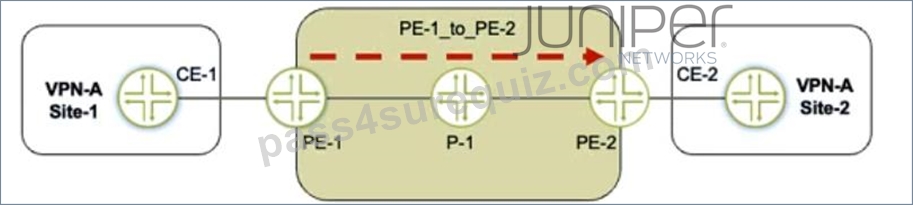
Referring to the exhibit, a working L3VPN exists that connects VPN-A sites CoS is configured correctly to match on the MPLS EXP bits of the LSP, but when traffic is sent from Site-1 to Site-2, PE-2 is not classifying the traffic correctly What should you do to solve the problem?
- A. Configure the explicit-null statement on PE-1.
- B. Configure VPN prefix mapping for the PE-1_to_PE-2 LSP
- C. Set a static CoS value for the PE-1_to_PE-2 LSP
- D. Configure the explicit-null statement on PE-2
Answer: D
Explanation:
Understanding the Problem in MPLS CoS Classification
How EXP Bits Are Used for CoS in MPLS
Traffic is sent from VPN-A Site-1 → CE-1 → PE-1 → P-1 → PE-2 → CE-2.
The MPLS LSP (Label Switched Path) from PE-1 to PE-2 is expected to carry MPLS EXP bits, which are used for Class of Service (CoS) classification.
PE-2 should classify traffic based on EXP bits received in the MPLS label.
What Happens with PHP (Penultimate Hop Popping)?
By default, the penultimate router (P-1) pops the top MPLS label before sending the packet to PE-2.
Since the EXP bits are in the top MPLS label, they get removed along with the label.
This means that PE-2 no longer sees the correct EXP bits, leading to incorrect traffic classification.
Solution: Configure Explicit-Null on PE-2
Explicit Null (explicit-null) must be configured on PE-2 to ensure that P-1 does NOT remove the MPLS label.
Instead of removing the label, P-1 will send a label of 0 (for IPv4) or 2 (for IPv6) to PE-2.
This preserves the MPLS EXP bits, allowing PE-2 to classify the traffic correctly.
Evaluating the Answer Choices Again
✅ B. Configure the explicit-null statement on PE-2.
Correct, because:
PE-2 is the egress LSR, where Ultimate Hop Popping (UHP) must be enabled.
Configuring explicit-null ensures that P-1 does not remove the label, preserving the EXP bits for CoS classification at PE-2.
Configuration on PE-2:
set protocols mpls explicit-null
Juniper Documentation Reference:
"Explicit-null must be configured on the egress LSR to prevent PHP from removing the top MPLS label, thereby preserving the EXP bits."
❌ A. Configure the explicit-null statement on PE-1.
Incorrect, because:
Explicit-null must be configured on the egress LSR (PE-2), not the ingress LSR (PE-1).
PE-1 only labels the traffic but does not control PHP behavior on P-1.
❌ C. Configure VPN prefix mapping for the PE-1_to_PE-2 LSP.
Incorrect, because:
VPN prefix mapping is used for mapping VPN routes to LSPs but does not solve the EXP bit issue.
The problem here is label removal (PHP), not route mapping.
❌ D. Set a static CoS value for the PE-1_to-PE-2 LSP.
Incorrect, because:
This does not preserve the original EXP bits, it only applies a static CoS value.
It's a workaround, not a fix.
Final answer: ✅ B. Configure the explicit-null statement on PE-2.
Key Takeaways
Penultimate Hop Popping (PHP) removes the outer MPLS label at P-1, which also removes the EXP bits used for CoS classification.
To keep EXP bits intact, configure explicit-null on the egress PE (PE-2).
This forces P-1 to send a label (0 for IPv4, 2 for IPv6) to PE-2, preserving the EXP bits for CoS classification.
Official Juniper Documentation Reference
Juniper MPLS CoS and PHP Behavior Guide
"To retain CoS EXP bits at the egress LSR, configure explicit-null on the egress PE. This prevents PHP from stripping the MPLS label before reaching the final PE router."
NEW QUESTION # 36
Refer to the exhibit.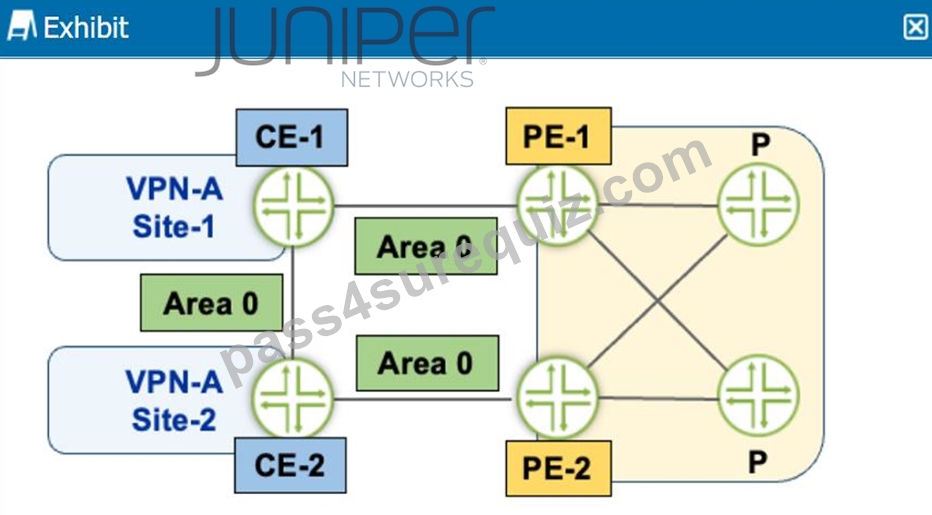
Click the Exhibit button.
Referring to the exhibit, the PE-to-CE protocol being used is OSPF for the L3VPN. Also, there is an OSPF neighborship between CE-1 and CE-2.
Which statement is correct in this situation?
- A. You must set a high metric on the CE-1 to PE-1 link for hosts at Site-1 to use the CE-1 to CE-2 link to reach hosts at Site-2.
- B. You must set a high metric on the CE-1 to CE-2 link for hosts at Site-1 to use the L3VPN to reach hosts at Site-2.
- C. Hosts at Site-1 will reach hosts at Site-2 through the CE-1 and CE-2 link by default.
- D. Hosts at Site-1 will reach hosts at Site-2 through the L3VPN by default.
Answer: C
Explanation:
In the exhibit, the PE-to-CE protocol used is OSPF, and there is an OSPF neighborship between CE-1 and CE-2 within the same Area 0. Let's analyze the default OSPF routing behavior in this setup to determine the correct statement.
1. **OSPF Neighborship**:
- CE-1 and CE-2 have an OSPF neighborship directly within Area 0.
- OSPF prefers intra-area routes over inter-area and external routes.
2. **Default Routing Behavior**:
- Since CE-1 and CE-2 are directly connected through an OSPF link within the same area, OSPF will prefer this direct intra-area path over any other paths learned via the PE routers and the L3VPN.
- This is because intra-area routes have a lower metric compared to inter-area or external routes.
3. **Metric Considerations**:
- By default, OSPF will route traffic between Site-1 and Site-2 through the direct link between CE-1 and CE-2, unless the link's metric is artificially increased to make it less preferable.
- There is no need to adjust metrics for the CE-1 to PE-1 link to prefer the CE-1 to CE-2 path, as OSPF already prefers direct intra-area paths.
**Conclusion**:
Given the default behavior of OSPF and the topology shown in the exhibit, the correct statement is:
**B. Hosts at Site-1 will reach hosts at Site-2 through the CE-1 and CE-2 link by default.**
**Reference**:
- OSPF Design Guide: [Juniper Networks OSPF Design Guide](https://www.juniper.net/documentation/en_US/junos/topics/concept/ospf-design-overview.html)
- Juniper Networks Technical Documentation on OSPF: [Junos OS OSPF Configuration Guide](https://www.juniper.net/documentation/en_US/junos/topics/concept/ospf-routing-overview.html)
NEW QUESTION # 37
Which two statements about the output shown in the exhibit are correct? (Choose two.)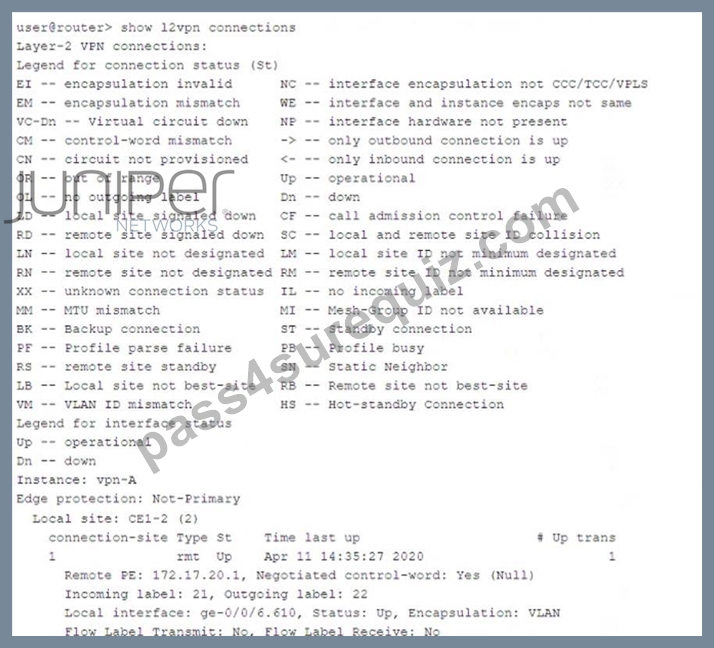
- A. The PE is attached to a single local site.
- B. The connection has not flapped since it was initiated.
- C. There has been a VLAN ID mismatch.
- D. The PE router has the capability to pop flow labels.
Answer: A,B
NEW QUESTION # 38 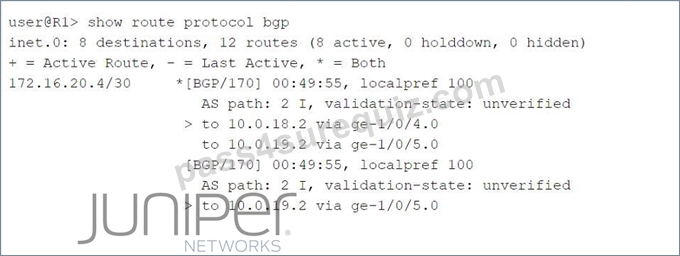
Click the Exhibit button.
Referring to the exhibit, which two statements are true? (Choose two.)
- A. This route is learned from two different AS numbers.
- B. This route is learned from the same AS number.
- C. The multipath configuration is used for load balancing.
- D. The multihop configuration is used for load balancing.
Answer: B,C
Explanation:
In the exhibit, the output of the `show route protocol bgp` command is shown for the prefix `172.16.20.4/30`.
Let's analyze the provided BGP routing table to determine which statements are correct.
1. **AS Path Analysis**:
- The AS path for the route `172.16.20.4/30` is shown as `2 I`.
- This indicates that the route was learned from AS 2 and it is an internal (iBGP) route within the same AS.
2. **Multiple Paths**:
- The route has two next-hop IP addresses: `10.0.18.2` via interface `ge-1/0/4.0` and `10.0.19.2` via interface
`ge-1/0/5.0`.
- This indicates that BGP multipath is configured, which allows multiple equal-cost paths to be used for load balancing.
- BGP multipath must be explicitly configured to use multiple paths for the same prefix.
3. **Multihop vs. Multipath**:
- **Multihop Configuration**: This is typically used for establishing BGP sessions with peers that are not directly connected. It is not related to load balancing.
- **Multipath Configuration**: This is used to enable load balancing across multiple paths for the same prefix, which is the case here.
**Conclusion**:
Given the above analysis:
- **C. This route is learned from the same AS number**: Correct. The AS path `2 I` indicates the route was learned from the same AS number (AS 2).
- **D. The multipath configuration is used for load balancing**: Correct. The presence of multiple next-hops indicates that BGP multipath is configured for load balancing.
Thus, the correct answers are:
**C. This route is learned from the same AS number.**
**D. The multipath configuration is used for load balancing.**
**References**:
- Junos OS BGP Multipath Documentation: [Junos OS BGP
Multipath](https://www.juniper.net/documentation/en_US/junos/topics/topic-map/bgp-multipath.html)
- Junos OS BGP Configuration Guide: [Junos OS BGP
Configuration](https://www.juniper.net/documentation/en_US/junos/topics/concept/bgp-routing-overview.html)
NEW QUESTION # 39
You are configuring schedulers to define the class-of-service properties of output queues. You want to control packet drops during periods of congestion.
In this scenario, which CoS configuration parameter would be used to accomplish this task?
- A. priority
- B. shaping rate
- C. drop profile
- D. buffer size
Answer: C
Explanation:
When configuring Class of Service (CoS) properties for output queues, we need to manage packet drops during periods of congestion. Juniper's CoS framework provides several tools to manage congestion, including drop profiles, buffer sizes, and scheduling mechanisms. Let's break down each option and identify the correct one.
Evaluating the Answer Choices
✅ D. drop profile (Correct Answer)
Why?
A drop profile defines when packets should be dropped based on the queue fill level.
Random Early Detection (RED) or Tail Drop can be used to manage congestion by discarding lower-priority packets first.
Drop profiles are configured under the scheduler to determine how aggressive packet dropping should be during congestion.
Example Juniper Configuration:
schedulers {
best-effort {
drop-profile low-drop;
}
}
drop-profiles {
low-drop {
fill-level 80 drop-probability 50;
}
}
fill-level 80 → When the queue reaches 80% full, packet drops begin.
drop-probability 50 → There is a 50% chance of dropping packets once the threshold is reached.
Official Juniper Documentation Reference:
Junos Class of Service Configuration Guide
"A drop profile determines how packets are discarded based on the queue fill level, allowing control over congestion behavior." Why the Other Options Are Incorrect?
❌ A. buffer size (Incorrect)
Why?
The buffer size determines how many packets the queue can store before congestion occurs.
A larger buffer can delay drops, but it does not actively control dropping behavior.
It affects latency rather than controlling packet drops.
❌ B. priority (Incorrect)
Why?
Priority controls which queue gets serviced first, not how drops are handled.
Higher priority queues are serviced before lower-priority queues, but this does not prevent congestion-related drops.
❌ C. shaping rate (Incorrect)
Why?
Shaping limits the maximum transmission rate of the queue.
While shaping helps reduce congestion, it does not control which packets get dropped during congestion.
Shaping is useful for traffic smoothing, but it does not actively drop packets based on queue fill levels.
Final answer: ✅ D. drop profile
Controls packet drops based on queue congestion.
Defines RED (Random Early Detection) or Tail Drop mechanisms.
Directly influences drop probability as the queue fills up.
Official Juniper Reference:
"Drop profiles are used to manage congestion by determining when and how aggressively packets are dropped based on queue fill level."
NEW QUESTION # 40
Exhibit
user@Rl show configuration interpolated-profile { interpolate {
fill-level [ 50 75 drop-probability [ > }
class-of-service drop-profiles
];
20 60 ];
Which two statements are correct about the class-of-service configuration shown in the exhibit? (Choose two.)
- A. The drop probability gradually increases from 20% to 60% as the queue level increases from 50% full to 75% full
- B. To use this drop profile, you reference it in a scheduler.
- C. The drop probability jumps immediately from 20% to 60% when the queue level reaches 75% full.
- D. To use this drop profile, you apply it directly to an interface.
Answer: A,B
Explanation:
class-of-service (CoS) is a feature that allows you to prioritize and manage network traffic based on various criteria, such as application type, user group, or packet loss priority. CoS uses different components to classify, mark, queue, schedule, shape, and drop traffic according to the configured policies.
One of the components of CoS is drop profiles, which define how packets are dropped when a queue is congested. Drop profiles use random early detection (RED) algorithm to drop packets randomly before the queue is full, which helps to avoid global synchronization and improve network performance. Drop profiles can be discrete or interpolated. A discrete drop profile maps a specific fill level of a queue to a specific drop probability. An interpolated drop profile maps a range of fill levels of a queue to a range of drop probabilities and interpolates the values in between.
In the exhibit, we can see that the class-of-service configuration shows an interpolated drop profile with two fill levels (50 and 75) and two drop probabilities (20 and 60). Based on this configuration, we can infer the following statements:
* The drop probability jumps immediately from 20% to 60% when the queue level reaches 75% full. This is not correct because the drop profile is interpolated, not discrete. This means that the drop probability gradually increases from 20% to 60% as the queue level increases from 50% full to 75% full. The drop probability for any fill level between 50% and 75% can be calculated by using linear interpolation formula.
* The drop probability gradually increases from 20% to 60% as the queue level increases from 50% full to 75% full. This is correct because the drop profile is interpolated and uses linear interpolation formula to calculate the drop probability for any fill level between 50% and 75%. For example, if the fill level is
60%, the drop probability is 28%, which is calculated by using the formula: (60 - 50) / (75 - 50) * (60 -
20) + 20 = 28.
* To use this drop profile, you reference it in a scheduler. This is correct because a scheduler is a component of CoS that determines how packets are dequeued from different queues and transmitted on an interface. A scheduler can reference a drop profile by using the random-detect statement under the
[edit class-of-service schedulers] hierarchy level. For example: scheduler test { transmit-rate percent 10; buffer-size percent 10; random-detect test-profile; }
* To use this drop profile, you apply it directly to an interface. This is not correct because a drop profile cannot be applied directly to an interface. A drop profile can only be referenced by a scheduler, which can be applied to an interface by using the scheduler-map statement under the [edit class-of-service interfaces] hierarchy level. For example: interfaces ge-0/0/0 { unit 0 { scheduler-map test-map; } }
NEW QUESTION # 41 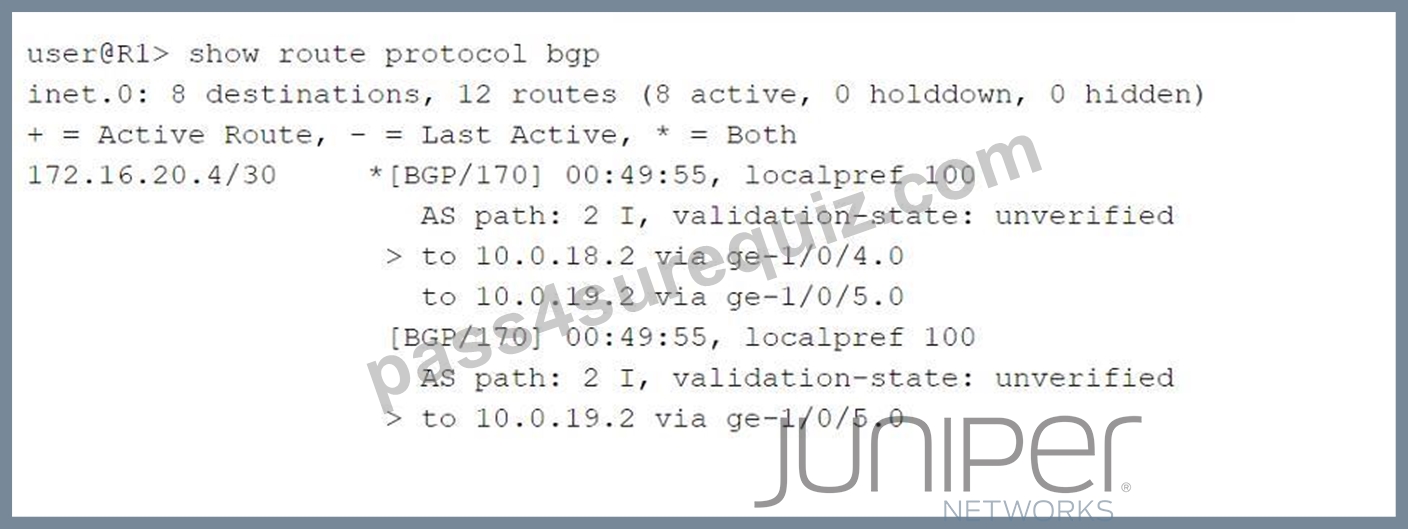
Click the Exhibit button.
Referring to the exhibit, which two statements are true? (Choose two.)
- A. This route is learned from two different AS numbers.
- B. This route is learned from the same AS number.
- C. The multipath configuration is used for load balancing.
- D. The multihop configuration is used for load balancing.
Answer: B,C
Explanation:
In the exhibit, the output of the `show route protocol bgp` command is shown for the prefix `172.16.20.4/30`.
Let's analyze the provided BGP routing table to determine which statements are correct.
1. **AS Path Analysis**:
- The AS path for the route `172.16.20.4/30` is shown as `2 I`.
- This indicates that the route was learned from AS 2 and it is an internal (iBGP) route within the same AS.
2. **Multiple Paths**:
- The route has two next-hop IP addresses: `10.0.18.2` via interface `ge-1/0/4.0` and `10.0.19.2` via interface
`ge-1/0/5.0`.
- This indicates that BGP multipath is configured, which allows multiple equal-cost paths to be used for load balancing.
- BGP multipath must be explicitly configured to use multiple paths for the same prefix.
3. **Multihop vs. Multipath**:
- **Multihop Configuration**: This is typically used for establishing BGP sessions with peers that are not directly connected. It is not related to load balancing.
- **Multipath Configuration**: This is used to enable load balancing across multiple paths for the same prefix, which is the case here.
**Conclusion**:
Given the above analysis:
- **C. This route is learned from the same AS number**: Correct. The AS path `2 I` indicates the route was learned from the same AS number (AS 2).
- **D. The multipath configuration is used for load balancing**: Correct. The presence of multiple next-hops indicates that BGP multipath is configured for load balancing.
Thus, the correct answers are:
**C. This route is learned from the same AS number.**
**D. The multipath configuration is used for load balancing.**
**References**:
- Junos OS BGP Multipath Documentation: [Junos OS BGP Multipath](https://www.juniper.net
/documentation/en_US/junos/topics/topic-map/bgp-multipath.html)
- Junos OS BGP Configuration Guide: [Junos OS BGP Configuration](https://www.juniper.net/documentation
/en_US/junos/topics/concept/bgp-routing-overview.html)
NEW QUESTION # 42
Exhibit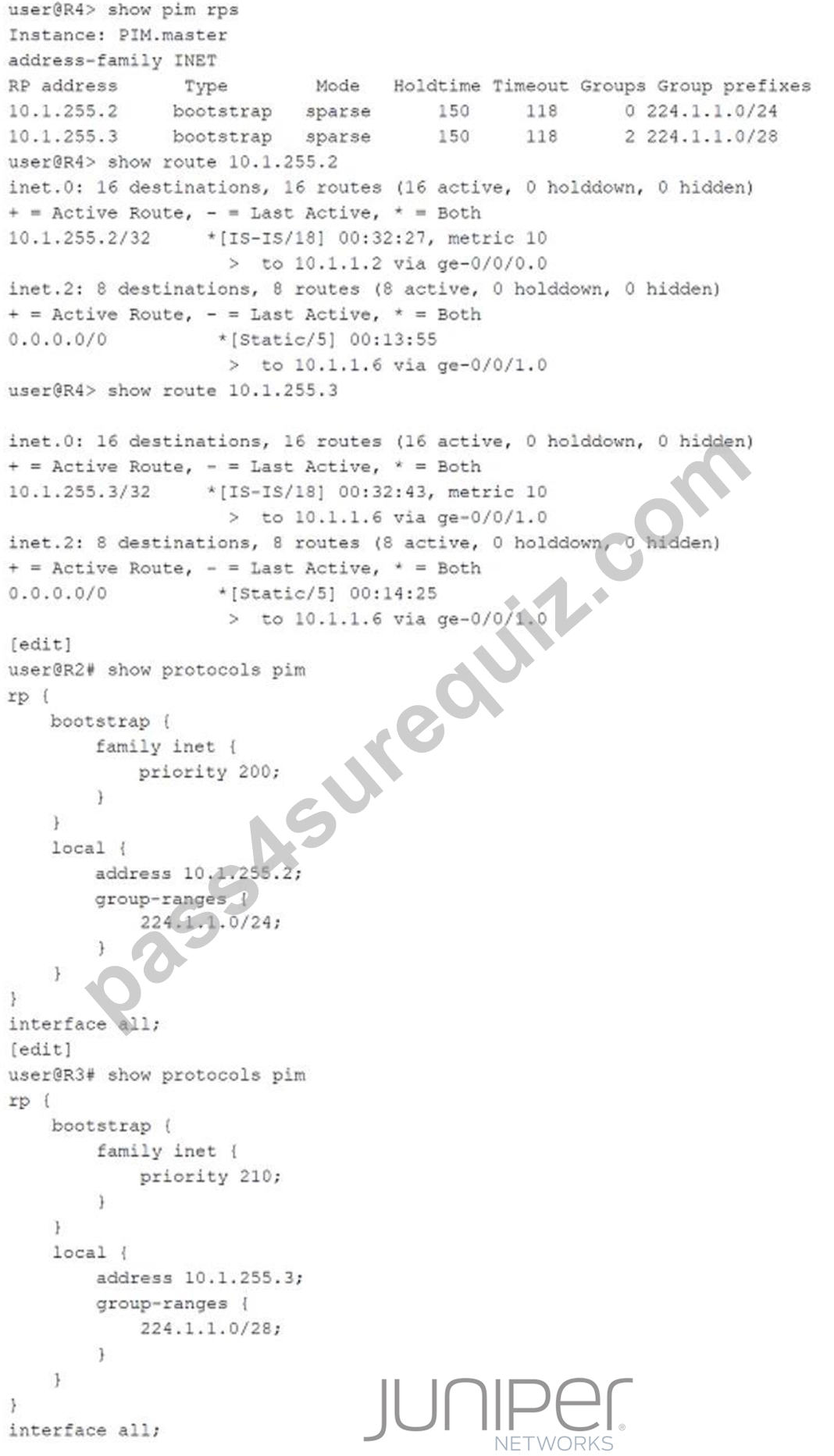
R4 is directly connected to both RPs (R2 and R3) R4 is currently sending all ,o,ns upstream to R3 but you want all joins to go to R2 instead Referring to the exhibit, which configuration change will solve this issue?
- A. Change the default route in inet.2 on R4 from R3 as the next hop to R2
- B. Change the bootstrap priority on R2 to be higher than R3
- C. Change the local address on R2 to be higher than R3.
- D. Change the group-range to be more specific on R2 than R3.
Answer: D
NEW QUESTION # 43
You have an L2VPN connecting two CEs across a provider network that runs OSPF. You have OSPF configured on both CEs.
Which two statements are correct in this scenario? (Choose two.)
- A. The CE and PE OSPF areas can be different.
- B. OSPF neighborship is formed between the CEs and PEs.
- C. The CE and PE OSPF areas must match.
- D. OSPF neighborship is formed between the two CEs.
Answer: A,D
Explanation:
In an L2VPN scenario, the provider network connects two customer edge (CE) devices across a Layer 2 virtual private network. Let's analyze how OSPF operates in this setup.
1. **OSPF Neighborship in L2VPN**:
- An L2VPN provides a Layer 2 connection between two sites, making it transparent to Layer 3 protocols like OSPF. This means the CEs can form OSPF adjacencies directly with each other as if they were on the same local network.
2. **OSPF Configuration on CEs and PEs**:
- **Statement A: OSPF neighborship is formed between the CEs and PEs**:
- Incorrect. In an L2VPN, the provider's network is transparent to the OSPF running on the CEs. OSPF neighborship forms directly between the CEs, not between the CEs and PEs.
- **Statement B: The CE and PE OSPF areas can be different**:
- Correct. Since OSPF adjacencies form directly between the CEs and not between CEs and PEs, the OSPF areas on the CEs and PEs can be different. The provider network acts as a transparent bridge, and OSPF doesn't see the PEs.
- **Statement C: The CE and PE OSPF areas must match**:
- Incorrect. As noted above, because the OSPF neighborship forms directly between the CEs, the OSPF areas on the CEs and PEs do not need to match.
- **Statement D: OSPF neighborship is formed between the two CEs**:
- Correct. The L2VPN makes the connection between the two CEs appear as a direct Layer 2 link, allowing them to form an OSPF adjacency directly.
**Conclusion**:
Given the above analysis, the correct statements are:
**B. The CE and PE OSPF areas can be different.**
**D. OSPF neighborship is formed between the two CEs.**
**Reference**:
- Juniper Networks Documentation on L2VPNs: [Configuring Layer 2 VPNs](https://www.juniper.net/documentation/en_US/junos/topics/task/configuration/layer-2-vpns-configuring.html)
- OSPF Configuration Guide: [Junos OS OSPF Configuration](https://www.juniper.net/documentation/en_US/junos/topics/concept/ospf-routing-overview.html)
NEW QUESTION # 44
Exhibit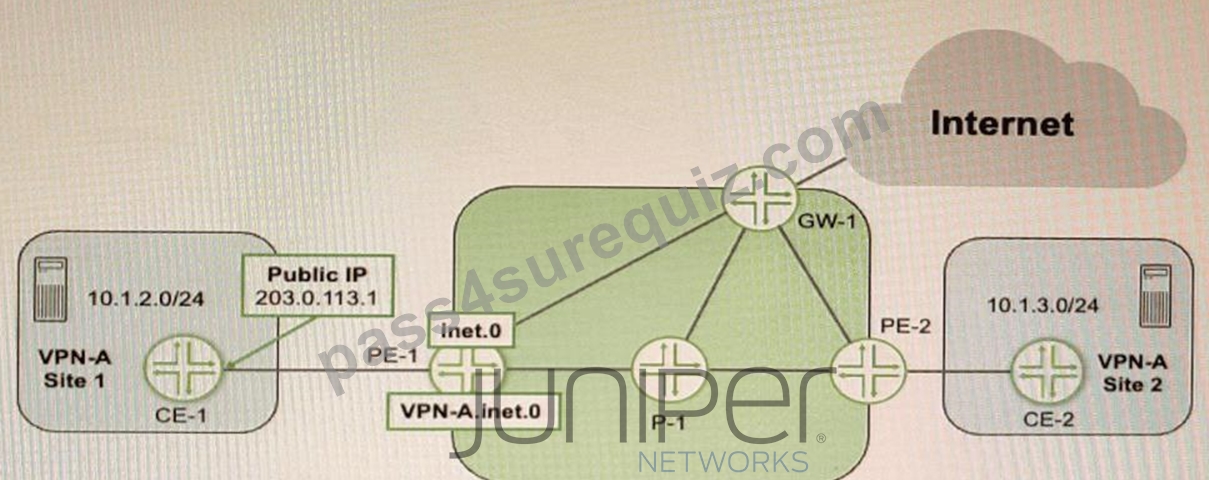
Referring to the exhibit, CE-1 is providing NAT services for the hosts at Site 1 and you must provide Internet access for those hosts Which two statements are correct in this scenario? (Choose two.)
- A. You must configure a RIB group on PE-1 to leak the 10 1 2.0/24 prefix from the VPN-A.inet.0 table to the inet.0 table.
- B. You must configure a RIB group on PE-1 to leak a default route from the inet.0 table to the VPN-A.inet.
0 table. - C. You must configure a static route in the main routing instance for the 203.0.113.1/32 prefix that uses the VPN-A.inet.0 table as the next hop.
- D. You must configure a static route in the main routing instance for the 10 1 2.0/24 prefix that uses the VPN-A.inet.0 table as the next hop
Answer: B,C
NEW QUESTION # 45
Exhibit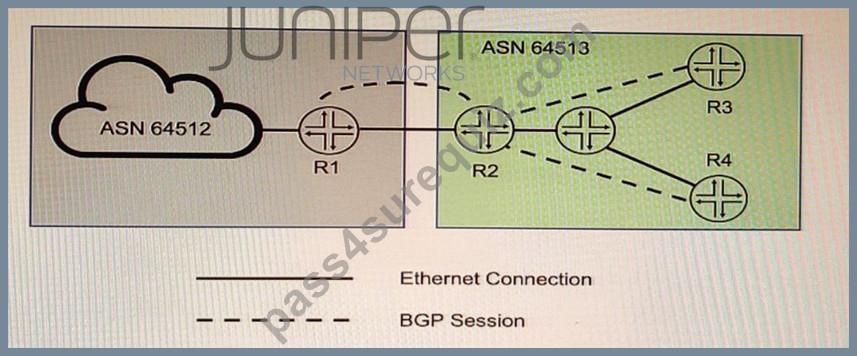
You want to implement the BGP Generalized TTL Security Mechanism (GTSM) on the network Which three statements are correct in this scenario? (Choose three)
- A. You can implement BGP GTSM between R2, R3, and R4
- B. BGP GTSM requires a TTL of 255 to be configured between neighbors.
- C. You can implement BGP GTSM between R2 and R1.
- D. BGP GTSM requires a firewall filter to discard packets with incorrect TTL.
- E. BGP GTSM requires a TTL of 1 to be configured between neighbors.
Answer: A,B,E
Explanation:
Explanation
BGP GTSM is a technique that protects a BGP session by comparing the TTL value in the IP header of incoming BGP packets against a valid TTL range. If the TTL value is within the valid TTL range, the packet is accepted. If not, the packet is discarded. The valid TTL range is from 255 - the configured hop count + 1 to
255. When GTSM is configured, the BGP packets sent by the device have a TTL of 255. GTSM provides best protection for directly connected EBGP sessions, but not for multihop EBGP or IBGP sessions because the TTL of packets might be modified by intermediate devices.
In the exhibit, we can see that R2, R3, and R4 are in the same AS (AS 20) and R1 is in a different AS (AS 10).
Based on this information, we can infer the following statements:
* You can implement BGP GTSM between R2, R3, and R4. This is not correct because R2, R3, and R4 are IBGP peers and GTSM does not provide effective protection for IBGP sessions. The TTL of packets between IBGP peers might be changed by intermediate devices or routing protocols.
* BGP GTSM requires a firewall filter to discard packets with incorrect TTL. This is not correct because BGP GTSM does not require a firewall filter to discard packets with incorrect TTL. BGP GTSM uses TCP option 19 to negotiate GTSM capability between peers and uses TCP option 20 to carry the expected TTL value in each packet. The receiver checks the expected TTL value against the actual TTL value and discards packets with incorrect TTL values.
* You can implement BGP GTSM between R2 and R1. This is correct because R2 and R1 are EBGP peers and GTSM provides effective protection for directly connected EBGP sessions. The TTL of packets between directly connected EBGP peers is not changed by intermediate devices or routing protocols.
* BGP GTSM requires a TTL of 1 to be configured between neighbors. This is not correct because BGP GTSM requires a TTL of 255 to be configured between neighbors. The sender sets the TTL of packets to 255 and the receiver expects the TTL of packets to be 255 minus the configured hop count.
* BGP GTSM requires a TTL of 255 to be configured between neighbors. This is correct because BGP GTSM requires a TTL of 255 to be configured between neighbors. The sender sets the TTL of packets to 255 and the receiver expects the TTL of packets to be 255 minus the configured hop count.
NEW QUESTION # 46
By default, which statement is correct about OSPF summary LSAs?
- A. The area-range command must be installed on all routers.
- B. All Type 2 and Type 7 LSAs will be summanzed into a single Type 5 LSA
- C. The metric associated with a summary route will be equal to the lowest metric associated with an individual contributing route
- D. Type 3 LSAs are advertised for routes in Type 1 LSAs.
Answer: D
Explanation:
Explanation
OSPF uses different types of LSAs to describe different aspects of the network topology. Type 1 LSAs are also known as router LSAs, and they describe the links and interfaces of a router within an area. Type 3 LSAs are also known as summary LSAs, and they describe routes to networks outside an area but within the same autonomous system (AS). By default, OSPF will summarize routes from Type 1 LSAs into Type 3 LSAs when advertising them across area boundaries .
NEW QUESTION # 47
Your network is receiving the 203.0.113.0/24 network using EBGP from AS 64500 and AS 64501. Both of these advertisements have identical local-preference values, AS-path lengths, and BGP origin codes. You want to influence the way your AS sends traffic to the 203.0.113.0/24 network.
In this scenario, which attribute would you consider next when selecting the best path?
- A. MED value
- B. IGP metric
- C. router ID
- D. peer IP address
Answer: C
Explanation:
as by default, the MED attribute is only compared for routes received from the same neighbouring AS. The next feasible tiebreaker in the BGP route selection algorithm would be Router ID.
NEW QUESTION # 48
......
Juniper JN0-664: Service Provider, Professional (JNCIP-SP) exam is designed for professionals who want to enhance their skills and knowledge in the field of service provider technologies. Service Provider, Professional (JNCIP-SP) certification is a proof of the skills and knowledge that a candidate possesses in configuring and troubleshooting service provider routing technologies and implementing service provider VPN solutions.
100% Free JN0-664 Daily Practice Exam With 99 Questions: https://actualanswers.pass4surequiz.com/JN0-664-exam-quiz.html