

Databricks-Machine-Learning-Professional Actual Questions - Instant Download 193 Questions
Download Free Latest Exam Databricks-Machine-Learning-Professional Certified Sample Questions
NEW QUESTION # 78
Which is a benefit of logging an input example with an MLflow model?
- A. The environment requirements are packaged with the MLmodel file
- B. An example prediction is available to test post-inference pipelines
- C. The model evaluation metrics are stored with the model
- D. An example record is available to test serving applications
Answer: D
Explanation:
Logging an input example with an MLflow model provides a concrete sample of the data format expected by the model. This helps serving applications and users understand the model's input structure and verify that inference requests are properly formatted when deploying or testing the model in production.
NEW QUESTION # 79
A machine learning engineer is converting a Hyperopt-based hyperparameter tuning process from manual MLflow logging to MLflow Autologging. They notice that not all details and objects are automatically logged, and they will need to manually log some things. Which of the following will need to be manually logged when performing nested runs with Hyperopt and MLflow Autologging?
- A. Best trial evaluation metric
- B. Evaluation metrics
- C. Hyperparameter values
- D. Trial models
- E. Trial status
Answer: A
Explanation:
When using MLflow Autologging with Hyperopt and nested runs, the best trial evaluation metric is not automatically logged and must be logged manually. Autologging captures trial-level details like hyperparameters and evaluation metrics, but summarizing and logging the overall best trial's result is a manual responsibility of the engineer.
NEW QUESTION # 80
Which stage in the MLflow Model Registry is typically used for models currently serving production traffic?
- A. Archived
- B. Staging
- C. None
- D. Production
Answer: D
Explanation:
In MLflow Model Registry stages:
Staging -> testing before release
Production -> serving real users
Archived -> retired models
NEW QUESTION # 81
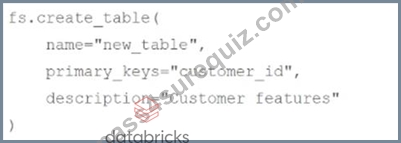
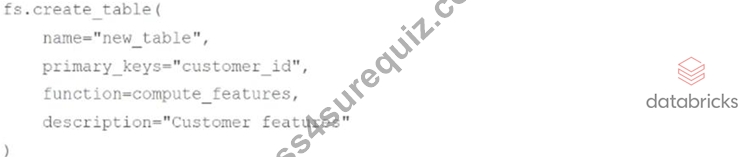
A data scientist has created a Python function compute_features that returns a Spark DataFrame with the following schema:
The resulting DataFrame is assigned to the features_df variable. The data scientist wants to create a Feature Store table using features_df.
Which of the following code blocks can they use to create and populate the Feature Store table using the Feature Store Client fs?
- A. features_df.write.mode("feature").path("new_table")
- B. features_df.write.mode("fs").path("new_table")
- C.
- D.

- E.
Answer: E
NEW QUESTION # 82
A Machine Learning Engineer needs to deploy a production ML workflow that includes an MLflow experiment for tracking model training runs, a registered model in Unity Catalog for version management, and a model serving endpoint for real-time inference. The team requires a unified configuration approach that ensures consistent deployment across development and production environments while adhering to infrastructure-as-code best practices. Which approach should the Machine Learning Engineer use to define all three components together?
- A. Create separate REST API calls for each component and run them sequentially using a shell script.
- B. Use MLflow's deployment tools to create individual deployment configurations for each component, then orchestrate them using Databricks Jobs.
- C. Define experiments, registered_models, and model_serving_endpoints resources in a Databricks Asset Bundle (DAB) configuration file.
- D. Use Terraform to provision the infrastructure and then manually configure each ML component through the Databricks UI.
Answer: C
Explanation:
Databricks Asset Bundles allow experiments, Unity Catalog-registered models, and model serving endpoints to be defined declaratively in a single configuration. This provides a unified, version-controlled, infrastructure-as-code approach that ensures consistent deployment across environments and aligns with MLOps best practices.
NEW QUESTION # 83
A data scientist set up a machine learning pipeline to automatically log a data visualization with each run. They now want to view the visualizations in Databricks. Which location in Databricks will show these data visualizations?
- A. The Artifacts section of the MLflow Run page
- B. The MLflow Model Registry Model paqe
- C. Logged data visualizations cannot be viewed in Databricks
- D. The Figures section of the MLflow Run page
- E. The Artifacts section of the MLflow Experiment page
Answer: D
NEW QUESTION # 84
A machine learning engineering manager has asked all of the engineers on their team to add text descriptions to each of the model projects in the MLflow Model Registry. They are starting with the model project "model" and they'd like to add the text in the model_description variable.
The team is using the following line of code:
Which change does the team need to make to the above code block to accomplish the task?
- A. Add a Python model as an argument to update_registered_model
- B. Replace update_registered_model with update_model_version
- C. There no changes necessary
- D. Replace description with artifact
- E. Replace client.update_registered_model with mlflow
Answer: C
NEW QUESTION # 85
A machine learning engineer has developed a model and registered it using the FeatureStoreClient fs. The model has model URI model_uri. The engineer now needs to perform batch inference on the training set logged with the model, but a few of the feature values in the column spend have since been updated and arc present in the customer-level Spark DataFrame spark_df. The customer_id column is the primary key of spark_df and the training set used when training and logging the model. Which code block can be used to compute predictions for the training set while overwriting its old spend values with the new spend values from spark_df?
- A. df = fs.get_updated_feature(spark_df, model=uri)
fs.score_batch(model_uri, df) - B. fs.score_batch(model_uri, spark_df)
- C. df = fs.get_updated_features(spark_df)
fs.score_batch(model_uri, df) - D. fs.score_model(model_uri, spark_df)
Answer: C
Explanation:
To perform batch inference while incorporating updated feature values (like spend) from a DataFrame (spark_df), the correct approach is to use fs.get_updated_features(spark_df) to refresh the relevant features based on the primary key (customer_id), then score the model using fs.score_batch(...). This ensures predictions are made with the latest data.
NEW QUESTION # 86
A machine learning engineer has created a webhook with the following code block:
Which of the following code blocks will trigger this webhook to run the associate job?
- A.

- B.

- C.

- D.
- E.

Answer: B
NEW QUESTION # 87
A machine learning engineer is developing a recommendation system for online content. They are using the Databricks Feature Store to store features for training and inference. Which unit test should they create?
- A. Test that Pandas DataFrame operations work as expected
- B. Test feature transformation functions
- C. Test Feature Store lookup during inference
- D. Test MLflow Model Registry operations
Answer: B
Explanation:
When using the Databricks Feature Store, the most important unit tests validate that feature transformation logic produces correct and consistent outputs. Testing feature transformation functions ensures that features written to the Feature Store are accurate and reliable for both training and inference, independent of infrastructure or serving mechanisms.
NEW QUESTION # 88
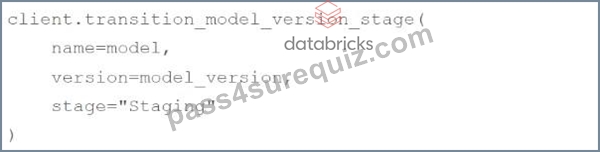
A machine learning engineer wants to move their model version model_version for the MLflow Model Registry model model from the Staging stage to the Production stage using MLflow Client client.
Which of the following code blocks can they use to accomplish the task?
- A.
- B.

- C.

- D.

- E.

Answer: A
NEW QUESTION # 89
A Machine Learning Engineer developed a dynamic pricing model in MLflow that requires values from the company's cloud database to generate predictions. At inference time the PyFunc model uses the cloud provider's Python SDK to retrieve the latest values from the database. The inference code works well in a notebook, but when the engineer deploys the model to Databricks Model Serving, they receive 401 errors saying the user is not authenticated when trying to access the database. The engineer deploys the code via the REST API with the following payload:
Their Databricks administrators store cloud credentials under a Databricks secret scope called
"cloud_creds" with key "db_key". These credentials can be used to authenticate to the cloud provider's SDK.
Which change can the engineer make so the endpoint can authenticate to the remote database while avoiding storing the access tokens in plain text?
- A. Retrieve the secret values using a notebook with dbutils.secrets.get(scope="cloud_creds", key="db_key"). Add "environment_vars":
{"DB_ACCESS_TOKEN": ""} to the served_entity. Change the PyFunc model code to read the environment variable and pass the secret to the cloud provider's SDK. - B. Add "environment_vars": {"DB_ACCESS_TOKEN": "{{secrets/cloud_creds/db_key}}"} to the served_entity. Change the PyFunc model code to read the environment variable and pass the secret to the cloud provider's SDK.
- C. Retrieve the secret values using a notebook with dbutils.secrets.get(scope="cloud_creds", key="db_key"). Log the model to MLflow with the access token value as a custom MLflow artifact.
Register the model in Unity Catalog. Change the PyFunc model code to read the artifact and pass the secret to the cloud provider's SDK. - D. Log the model to MLflow and store {{secrets/cloud_creds/db_key}} as a MLflow secret in
/.mlflow/credentials. Register the model in Unity Catalog. When deployed in Databricks Model Serving, MLflow will automatically authenticate when the model server starts.
Answer: B
Explanation:
Databricks Model Serving supports secure secret injection by referencing Databricks secret scopes directly in the served entity configuration. By mapping the secret to an environment variable using the {{secrets/scope/key}} syntax, the model can securely access the credential at runtime without exposing it in plain text. The PyFunc model can then read the environment variable and authenticate to the cloud provider's SDK, resolving the 401 error while following security best practices.
NEW QUESTION # 90
A Machine Learning Engineer has a real-time fraud detection model deployed that approves or blocks millions of transactions daily. They need to deploy a new version of the model with improved detection accuracy to this high-traffic, business-critical application. Because any model downtime could result in lost revenue or customer dissatisfaction, the engineer must ensure zero downtime and minimal disruption for end users. Leadership also requires that any rollback to the previous version be immediate if issues are detected with the new model in production. Which deployment strategy meets these requirements?
- A. Replace the current production model with the new version during a scheduled maintenance window, notify affected users of potential brief disruptions, and prepare to reroute requests to a backup if failures occur after deployment.
- B. Use a canary deployment by initially routing a small percentage of user traffic to the new model version, monitoring results, and gradually increasing exposure until all traffic uses the new version if no problems are detected.
- C. Deploy the new model in parallel with the old version, monitor both for a set period, and then notify all stakeholders to manually switch over to the new version at a coordinated time.
- D. Use a blue-green deployment for the new model, maintaining two separate production environments (one "blue," one "green") and switching user traffic to the new version only after confirming it is healthy, enabling instant rollback if needed.
Answer: D
Explanation:
A blue-green deployment maintains two fully operational production environments and shifts traffic between them instantly. This approach provides zero downtime during deployment and allows immediate rollback to the previous model version if issues arise, which is critical for high- traffic, business-critical real-time systems.
NEW QUESTION # 91
Why are Delta tables often used to store machine learning features?
- A. They support schema enforcement and time travel
- B. They allow faster GPU training
- C. They replace Spark DataFrames
- D. They reduce model size
Answer: A
Explanation:
Delta Lake provides:
ACID transactions
time travel
schema enforcement
These are essential for reproducible ML pipelines.
NEW QUESTION # 92
A machine learning engineer has registered a sklearn model in the MLflow Model Registry using the sklearn model flavor with UI model_uri.
Which of the following operations can be used to load the model as an sklearn object for batch deployment?
- A. mlflow.pyfunc.load_model(model_uri)
- B. mlflow.sklearn.read_model(model_uri)
- C. mlflow.pyfunc.read_model(model_uri)
- D. mlflow.spark.load_model(model_uri)
- E. mlflow.sklearn.load_model(model_uri)
Answer: A
NEW QUESTION # 93
Which of the following Databricks-managed MLflow capabilities is a centralized model store?
- A. Experiments
- B. Models
- C. Feature Store
- D. Model Serving
- E. Model Registry
Answer: E
NEW QUESTION # 94
A machine learning engineer has developed a model and registered it using the FeatureStoreClient fs. The model has model URI model_uri. The engineer now needs to perform batch inference on customer-level Spark DataFrame spark_df, but it is missing a few of the static features that were used when training the model. The customer_id column is the primary key of spark_df and the training set used when training and logging the model.
Which of the following code blocks can be used to compute predictions for spark_df when the missing feature values can be found in the Feature Store by searching for features by customer_id?
- A. df = fs.get_missing_features(spark_df, model_uri)
fs.score_batch(model_uri, df) - B. df = fs.get_missing_features(spark_df)
fs.score_batch(model_uri, df) - C. df = fs.get_missing_features(spark_df, model_uri)
fs.score_model(model_uri, df) - D. fs.score_batch(model_uri, spark_df)
- E. fs.score_model(model_uri, spark_df)
Answer: D
NEW QUESTION # 95
A Data Scientist at an online gaming company is creating a model to predict player churn. The company currently collects terabytes of player activity logs daily, which are stored in Databricks and processed for daily reporting. The Data Scientist has completed feature engineering and the resulting data is saved as a Delta Table with a size of 500GB. They need to next build the model for the most performant and cost-effective performance for Databricks. Which approach will do this?
- A. Load the feature data as a pandas DataFrame and train the model using scikit-learn's RandomForestClassifier on a single-node Databricks cluster.
- B. Load the feature data as a Spark DataFrame and train the model using SparkML's RandomForestClassifier on a multi-node Databricks cluster.
- C. Load the feature data as a pandas DataFrame and train the model using scikit-learn's RandomForestClassifier on a multi-node Databricks cluster.
- D. Load the feature data as a Spark DataFrame and train the model using Spark's DeepspeedTorchDistributor on a multi-node Databricks cluster.
Answer: B
Explanation:
A 500GB Delta Table is far beyond what is practical to load into a single pandas DataFrame, and scaling pandas-based scikit-learn training across nodes is not the right fit for this workload. Using a Spark DataFrame with Spark ML's RandomForestClassifier leverages distributed data processing and distributed model training on a multi-node cluster, which is the most performant and cost-effective approach for large tabular datasets in Databricks.
NEW QUESTION # 96
Why is Delta Lake time travel useful in ML pipelines?
- A. Faster model inference
- B. Reproducible training datasets
- C. Smaller datasets
- D. Model tuning
Answer: B
Explanation:
Time travel allows training on exact historical datasets.
NEW QUESTION # 97
......
Free Databricks Databricks-Machine-Learning-Professional Exam 2026 Practice Materials Collection: https://actualanswers.pass4surequiz.com/Databricks-Machine-Learning-Professional-exam-quiz.html