

(PDF) Certified System Administrator CIS-DF Exam and Certification Test Engine
Use CIS-DF Exam Dumps (2026 PDF Dumps) To Have Reliable CIS-DF Test Engine
ServiceNow CIS-DF Exam Syllabus Topics:
| Topic | Details |
|---|---|
| Topic 1 |
|
| Topic 2 |
|
| Topic 3 |
|
| Topic 4 |
|
| Topic 5 |
|
NEW QUESTION # 62
(Choose 2 options)
The following Reconciliation Rules were configured for ServiceNow, Altiris, and SCCM for the Windows Server (cmdb_ci_win_server) class: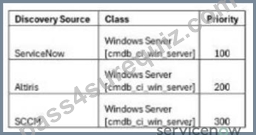
Which statements are true?
- A. Data collected with a discovery source of SCCM can be inserted as new records in the Windows Server table.
- B. Data collected with a discovery source of ServiceNow can insert new records into the Windows Server table, but cannot update records created by Altiris or SCCM.
- C. Data collected with a discovery source of Altiris can update records inserted by SCCM into the Windows Server table.
- D. Data collected with a discovery source of SCCM can update any record in the Windows Server table because it has the highest priority number.
Answer: A,C
Explanation:
This question tests understanding of reconciliation source priority in the Identification and Reconciliation Engine (IRE) in ServiceNow.
In reconciliation rules, lower numeric values represent higher priority. Therefore, the priority order is:
ServiceNow (100) - highest authority
Altiris (200)
SCCM (300) - lowest authority
Why A is correct
Because Altiris (200) has higher priority than SCCM (300), data from Altiris can update records originally inserted by SCCM. This is exactly how reconciliation precedence works-higher-priority sources can overwrite lower-priority ones.
Why C is correct
SCCM, even though it has the lowest priority, is still an authorized discovery source. It can insert new records into the Windows Server table when no existing CI is identified. Priority only affects updates, not the ability to create records.
Why B is incorrect
ServiceNow (priority 100) can update records from Altiris and SCCM because it has the highest priority. The statement incorrectly claims it cannot.
Why D is incorrect
SCCM does not have the highest authority. A higher numeric value means lower priority, so SCCM cannot update records created by higher-priority sources.
NEW QUESTION # 63
Which default user groups are available when setting up a CMDB Data Manager policy and specifying the task assignment with the Assignment type set to "User Group Field"? (Choose 2 options)
- A. Assignment Group
- B. Managed By Group
- C. Support Group
- D. Owned by Group
Answer: A,B
Explanation:
In ServiceNow Data Foundations, specifically within CMDB Data Manager, policies are used to enforce data quality, completeness, and governance across configuration items (CIs). When defining a Data Manager policy, administrators can configure task creation for non-compliant records and specify how those tasks are assigned. One key configuration is the Assignment type, where "User Group Field" allows assignment to a group dynamically based on a group reference field on the CI record.
Out of the box, ServiceNow provides two default and universally available group reference fields for this purpose:
* Assignment Group
* Managed By Group
These two fields are considered core CMDB governance fields and are consistently available across most CI classes. They align directly with ITIL 4 Service Configuration Management and CSDM accountability models, ensuring that remediation tasks are routed to teams responsible for operational ownership or technical management of the CI.
Assignment Group
This is the most commonly used operational field in ServiceNow. It represents the team responsible for working on tasks related to the CI and is fully supported by CMDB Data Manager for automated task assignment.
Managed By Group
This field represents the group accountable for managing the CI throughout its lifecycle. It is a standard CMDB field and is explicitly supported by Data Manager policies for governance-driven task routing.
NEW QUESTION # 64
What ensures data volume in the CMDB is manageable?
- A. Scheduled Jobs
- B. Archive Policies
- C. Business Rules
Answer: B
Explanation:
Managing CMDB data volume is a key Data Foundations governance objective. Over time, CMDBs naturally accumulate retired, obsolete, or decommissioned CIs. If these records are not properly managed, they degrade CMDB performance, reduce reporting accuracy, and negatively impact discovery reconciliation and health scores.
Archive Policies are the mechanism designed to address this challenge. They define when CI records should be archived or deleted based on lifecycle state, age, or retention requirements. By automating archival and cleanup, archive policies ensure that only relevant, active CIs remain in the operational CMDB, keeping data volume manageable and performant.
NEW QUESTION # 65
The Configuration Management team wants to confirm that all servers in the CMDB actually exist in the data center. Which CMDB Data Manager policy type would the team create? (Choose 1 option)
- A. Certification
- B. Attestation
- C. Retire
- D. Archive
- E. Delete
Answer: B
Explanation:
Within ServiceNow Data Foundations, CMDB Data Manager provides multiple policy types to support governance, data quality, and lifecycle management of configuration items (CIs). The scenario described--confirming that servers recorded in the CMDB physically exist in the data center--is a classic example of existence validation and ownership confirmation, which is exactly the purpose of an Attestation policy.
An Attestation policy is designed to request a human validation from a responsible individual or group (such as a data center manager, platform owner, or infrastructure team). The policy generates attestation tasks that require reviewers to explicitly confirm whether a CI is valid, accurate, and still exists. This aligns directly with CMDB governance best practices and ITIL 4 Service Configuration Management, where periodic verification ensures trust in the CMDB as a system of record.
NEW QUESTION # 66
A CMDB Administrator is using the Duplicate CI Remediator to address a de-duplication task. On the first tab of the wizard, the Main CI is selected.
Which attributes are used to identify the Main CI? (Choose two)
- A. Least Related Items
- B. Most Related Items
- C. Oldest Created
- D. Newest Created
Answer: B,C
Explanation:
In ServiceNow, the Duplicate CI Remediator is a governed tool designed to safely resolve duplicate Configuration Items while preserving the most valuable and authoritative record. The first step in the remediation wizard is identifying the Main CI, which will be retained after remediation.
ServiceNow uses two primary attributes to help determine the best candidate for the Main CI:
The oldest CI is often preferred because it typically has a longer operational history, may be referenced by historical incidents, changes, problems, or audits, and is more likely to be embedded in downstream processes and reports. Retaining the oldest CI helps avoid breaking historical references.
A CI with the most relationships (for example, links to applications, services, incidents, or other CIs) is generally the most valuable from a business and operational context perspective.
Preserving these relationships is critical for impact analysis, Change Management, and CSDM- aligned service modeling.
NEW QUESTION # 67
A new custom class is needed to reflect a new application being managed in the CMDB.
Which roles are minimally needed to add this custom CI class?
- A. sn_cmdb_admin and personalize_dictionary
- B. sn_cmdb_admin and personalize_form
- C. sn_cmdb_admin and personalize_dictionary
- D. itil_admin and personalize_form
Answer: A
Explanation:
Creating a custom CI class in the CMDB is a dictionary-level configuration activity and must be performed with the correct minimum privileges to ensure governance and upgrade safety in ServiceNow.
The sn_cmdb_admin role is required because it grants administrative access to CMDB structures, including CI class hierarchy management. This role ensures that changes align with CMDB governance controls and Data Foundations practices.
The personalize_dictionary role is also required because adding a new CI class involves creating or extending dictionary entries (tables, attributes, inheritance). Without dictionary-level access, a user cannot define new classes or attributes in the CMDB schema.
Option A is incorrect because sn_cmdb_admin alone is insufficient without dictionary privileges. Option B and D focus on form personalization, which affects UI layout only and does not allow creation of new CI classes. Additionally, itil_admin is not the correct role for schema-level CMDB changes.
Therefore, the minimal and correct role combination is sn_cmdb_admin and personalize_dictionary, making Option C the verified answer.
NEW QUESTION # 68
A CMDB Owner starts the CSDM journey and needs to become familiar with the CSDM domains.
Drag the CMDB objects to the correct CSDM domains.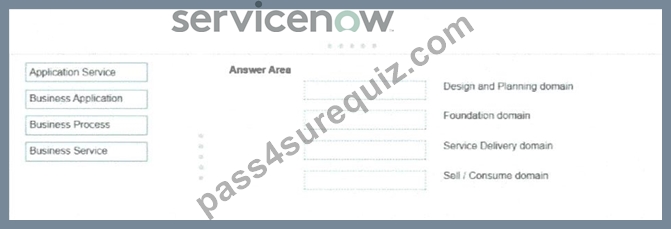
Answer:
Explanation: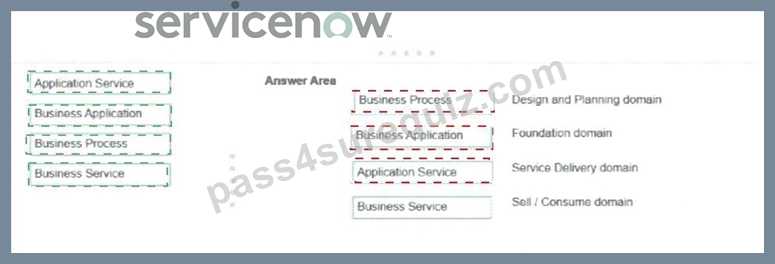
Explanation: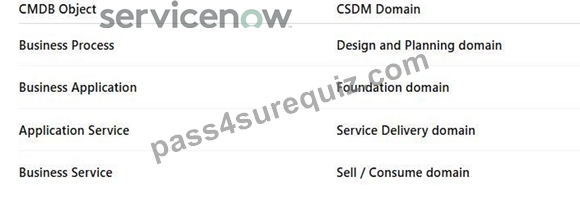
The Common Service Data Model (CSDM) organizes CMDB data into domains that reflect how services are planned, delivered, and consumed. Correct placement of objects is essential for reporting, ownership, and downstream ITSM, ITOM, and IRM use cases.
Design and Planning domain # Business Process
Business Processes describe how the business operates and what capabilities are required. These are planning constructs used to design services and applications before they are built or delivered.
Foundation domain # Business Application
Business Applications are foundational reference objects that represent what applications exist and who owns them. They anchor ownership, lifecycle, and governance but are not directly operational.
Service Delivery domain # Application Service
Application Services represent running, operational technical services (often created via Service Mapping).
They are central to Incident, Change, and Event Management, making them part of Service Delivery.
Sell / Consume domain # Business Service
Business Services represent what is offered to customers or consumers. They define value delivery, SLAs, and consumption context, which is why they belong in the Sell/Consume domain.
This mapping aligns with CSDM v5 guidance and ensures clear separation between planning constructs, foundational records, operational services, and consumer-facing services-a key principle for a scalable and governed CMDB.
NEW QUESTION # 69
ACMDB Administrator seeks to understand the available tools for preventing addressing, and remediating duplicate CIs Drag and drop each feature with the corresponding outcome Some options may not apply.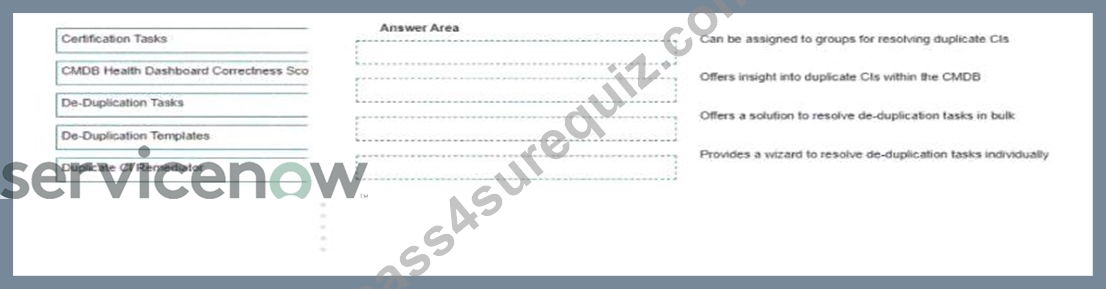
Answer:
Explanation: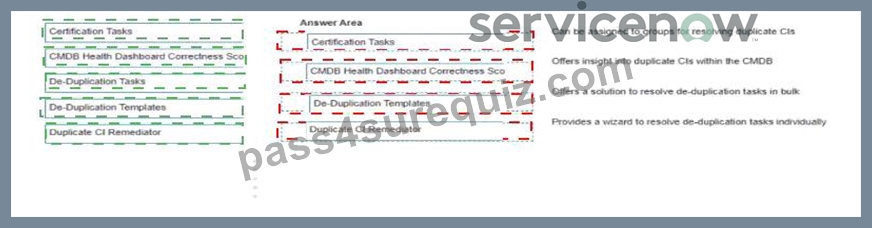
Explanation: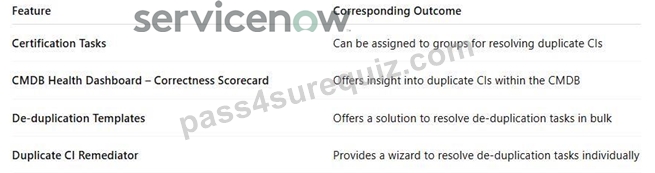
InServiceNow, duplicate CI management spansdetection, insight, and remediation:
TheCMDB Health Dashboard - Correctnesssurfaceswhere duplicates existand their impact, providing visibility and prioritization.
Certification Taskssupportgoverned resolution, allowing assignment to individuals or groups to validate and correct data.
De-duplication Templatesenablebulk remediation, ideal when standardized merge rules can be applied across many duplicates.
TheDuplicate CI Remediatoroffers aguided, record-by-record wizard, preserving relationships and history for safer individual resolutions.
De-duplication Tasksare the work items generated by these processes, but they do not themselves represent an outcome-hencenot applicable.
This mapping aligns withCMDB Data Foundations best practices, ensuring duplicates are identified, prioritized, and remediated efficiently and safely.
NEW QUESTION # 70
TheApache Web Server Identification Ruleis configured with the followingcriterion attributes:
Class
Configuration file
Version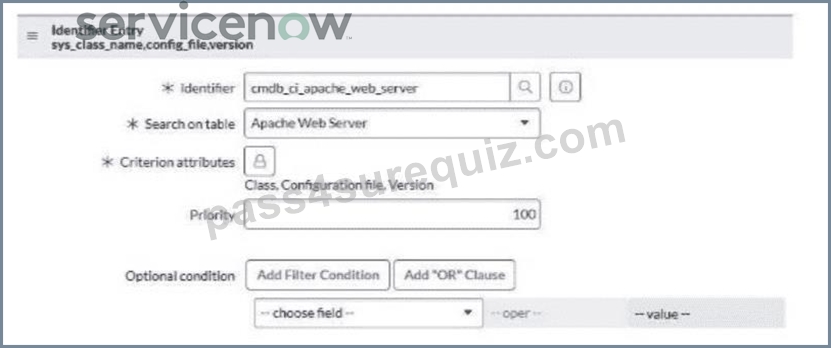
Yesterday, anApache Web Server CIwas discovered as part ofService Mapping.
Today, the application ownerupgraded Apache to a different versionand reran discovery of the service.
What will happen in the CMDB?
- A. A duplication error will occur.
- B. The Apache Web Server CI will be reclassified as a Web Server CI.
- C. The existing Apache Web Server CI will be reconciled and its version will be updated.
- D. A new Apache Web Server CI is created.
Answer: D
Explanation:
This scenario hinges on how theIdentification and Reconciliation Engine (IRE) inServiceNowevaluatesidentification rules.
The identification rule for theApache Web Serverclass includesVersionas part of theidentifier criteria, along with Class and Configuration file. Identification rules must matchall criterion attributes exactlyfor an incoming record to be identified as an existing CI and reconciled.
Yesterday's discovery created an Apache Web Server CI with a specific version value. When Apache is upgraded and discovery is rerun, theVersion attribute changes. Because Version is part of the identifier, the incoming recordno longer matchesthe existing CI's identifier entry. As a result, the IREcannot identify the existing CIas the same configuration item.
When identification fails and no matching identifier entry is found, the IRE proceeds toinsert a new CI recordrather than updating the existing one. This behavior is intentional and protects the CMDB from incorrectly reconciling records that no longer meet identification criteria.
Option A is incorrect because reconciliation only occursafter successful identification.
Option C is incorrect because reclassification is unrelated to identification criteria.
Option D is incorrect because this is not an error condition; it is expected IRE behavior.
This example highlights abest practice caution:volatile attributes (such as Version)should generallynot be used as identifier attributes, as they can cause unintended CI duplication during upgrades.
NEW QUESTION # 71
A CMDB Administrator is reviewing the CMDB and notices that many Hardware CIs are missing serial numbers. The Administrator is concerned this may cause duplicate CIs and wants to resolve the issue quickly.
What structured guidelines provided by ServiceNow are available to troubleshoot and resolve the issue?
- A. CSDM Data Foundations Dashboard Playbooks
- B. CMDB Health Dashboard Playbooks
- C. CSDM Now Create Playbooks
- D. CMDB Data Foundations Dashboard Playbooks
Answer: D
Explanation:
When data quality issues such as missing serial numbers threaten CMDB integrity and increase the risk of duplicates, ServiceNow provides prescriptive, step-by-step remediation guidance through the CMDB Data Foundations Dashboard Playbooks.
These playbooks are specifically designed to help administrators identify root causes, assess ingestion and governance gaps, and apply corrective actions using structured remediation plays (Analyze Data, Fix Data, Govern Data). For missing serial numbers, the playbooks guide teams to review Discovery patterns, identification rules, reconciliation sources, and governance controls to ensure authoritative data capture and prevention of future issues.
The CMDB Health Dashboard Playbooks focus on health scoring and metrics, not guided remediation. CSDM Data Foundations Dashboard Playbooks is not a distinct product naming; the correct construct is CMDB Data Foundations. Now Create Playbooks provide implementation project guidance, not operational troubleshooting for live data issues.
NEW QUESTION # 72
What is the recommended way to model shared middleware supporting multiple business services?
- A. Direct CI relationships to business services
- B. Store as an asset only
- C. Create a custom CI without relationships
- D. Create an Application Service representing middleware
Answer: D
Explanation:
Middleware should be modeled as an Application Service to support proper service abstraction and dependency mapping.
NEW QUESTION # 73
A Change Manager aims to streamline ITSM processes by automatically populating fields on the Change form when a CI is selected. The Configuration Management team ensures that the Change Group field is populated for all managed CIs.
As a result, which base system field on the Change form will be automatically populated after selecting a CI?
- A. Change Group
- B. Assignment Group
- C. Approval Group
- D. Managed by Group
Answer: A
Explanation:
In a mature Configuration Management implementation within ServiceNow, CI operational attributes are leveraged to automate Change Management workflows and reduce manual effort.
When a CI is selected on a Change record, ServiceNow evaluates the CI's Change Group attribute. If this field is populated on the CI, the platform automatically copies its value into the Change Group field on the Change form. This ensures that change ownership and governance are immediately aligned with the responsible technical team.
The Change Group is distinct from the Assignment Group, which is used primarily in Incident and Task routing. Managed by Group represents lifecycle ownership and is used by CMDB governance tools, while Approval Group controls approval workflows but is not auto-populated from CI selection.
This behavior demonstrates the value of accurate CI attributes: once populated consistently, they enable automatic field population, reduced manual errors, and faster processing across ITSM workflows.
Therefore, the correct answer is A - Change Group.
NEW QUESTION # 74
Which is a purpose or requirement of CMDB Data Manager in ServiceNow?
- A. Automates the enforcement of relationship rules between CIs in the CMDB
- B. Automates the archival and deletion of records based on retention policies
- C. Encrypts archived records for enhanced security
Answer: B
Explanation:
The CMDB Data Manager capability in ServiceNow is designed to support CMDB governance, specifically around data lifecycle management. Its primary purpose is to ensure that CI records are retained, archived, and deleted in accordance with defined retention policies, regulatory requirements, and organizational data governance standards.
As CMDBs mature, they naturally accumulate obsolete, retired, or decommissioned CIs. If these records are not properly managed, they negatively impact CMDB health, reporting accuracy, discovery reconciliation, and performance. CMDB Data Manager addresses this by automating the archival and deletion of records once lifecycle conditions and retention thresholds are met.
NEW QUESTION # 75
An organization needs to maintain non-discoverable attributes, such as warranty expiration dates, for hardware CIs. These attributes are not updated by automated discovery tools.
What method ensures these attributes are accurately maintained for all CIs?
- A. Use a scheduled data import to update the attributes from an external source
- B. Create a new CI class specifically for non-discoverable attributes
- C. Use the CMDB Reconciliation Engine to update the attributes
Answer: A
Explanation:
In Data Foundations, "Ingest" is not limited to Discovery. It includes establishing reliable sources and mechanisms to populate and maintain CMDB attributes--especially those that Discovery cannot provide. Warranty expiration dates are a classic example of non-discoverable data: they typically come from procurement systems, asset repositories, vendors, or contract tools rather than from device interrogation.
The correct approach is to maintain these attributes via a scheduled data import from an authoritative external source. This ensures ongoing accuracy and consistency at scale. A scheduled import allows you to define a repeatable integration pattern, apply data quality checks, and keep warranty data current as vendors and procurement records change--without relying on manual updates that inevitably drift over time.
NEW QUESTION # 76
The CMDB Administrator group aims to display meaningful results on the CMDB Health Dashboard - Compliance Scorecard for server records that are not on the latest patch.
What must be configured to achieve this goal?
- A. Certification Policies, Data Filters, Scheduled Jobs
- B. Certification Filter, Certification Template, Audit
- C. Stale, Orphan, Duplicate
- D. Technical Service Offerings, Dynamic CI Groups, CMDB Groups
Answer: A
Explanation:
In ServiceNow, the Compliance dimension of the CMDB Health Dashboard is driven by Data Certification.
To surface meaningful compliance results-such as identifying servers that are not on the latest patch-the platform requires a combination of Certification Policies, Data Filters, and Scheduled Jobs.
Certification Policies define what data must be validated and which attributes are subject to compliance checks (for example, patch level, OS version, or last update date). Data Filters scope the population-such as server classes only-ensuring the compliance evaluation targets the correct CIs. Scheduled Jobs automate when certifications run, keeping compliance scores current and reflective of the latest state.
Options A and C are incorrect because audits and stale/orphan/duplicate checks relate to other health dimensions (correctness and completeness), not compliance. Option B focuses on service modeling and group alignment, which does not directly drive compliance scoring for patch currency.
Therefore, configuring Certification Policies, Data Filters, and Scheduled Jobs is required to accurately measure and display patch compliance on the CMDB Health Dashboard.
NEW QUESTION # 77
What is the relationship between an Application and a Server?
- A. Application > Runs on::Runs > Server
- B. Application > Runs::Runs On > Server
- C. Application > Uses::Used by > Server
- D. Application > Used by::Uses > Server
Answer: A
Explanation:
In Data Foundations (CMDB and CSDM), relationship modeling must reflect real operational dependency so that incident triage, change impact analysis, and service visibility remain accurate. When an Application is hosted on a Server, the standard hosting-style relationship used in CMDB relationship governance is expressed as "Runs on::Runs". This pairing represents the two directional descriptors of the same relationship type: from the application perspective it runs on the server, and from the server perspective it runs the application.
This matters because CMDB relationships are used by downstream capabilities (for example, dependency views, impact calculations, and governance rules). Using the correct out-of-box relationship descriptor pair ensures consistent reporting and prevents confusion when teams traverse relationships "upstream" and
"downstream." In addition, relationship governance rules and inheritance are commonly built around standard relationship types; using the correct "Runs on::Runs" semantics supports validation across subclasses (for example, specific application and server subclasses) without requiring custom relationship definitions.
The other options are either reversed ("Runs::Runs On"), represent different semantics ("Uses::Used by"), or do not align with the typical hosting relationship naming used for application-to-server hosting dependencies.
Therefore, the correct relationship expression between an Application and a Server is Application > Runs on::
Runs > Server.
NEW QUESTION # 78
A CMDB Administrator has installed a Service Graph Connector and customized a script transform.
What will happen on subsequent upgrades if the default definition of the script transform is updated?
- A. The Service Graph Connector upgrade refuses to start
- B. The upgrade stops and reports an error
- C. A skipped change is created and no change is made to the script transform definition
Answer: C
Explanation:
In ServiceNow, Service Graph Connectors deliver data ingestion patterns using protected, upgrade- safe artifacts, including script transforms. When a customer customizes a script transform provided by a Service Graph Connector, ServiceNow follows standard update set and upgrade behavior to protect customer customizations.
During a subsequent upgrade, if the out-of-box (default) script transform definition changes, ServiceNow does not overwrite the customized version. Instead, the platform records a skipped change, indicating that an update was available but intentionally not applied due to a local customization. This ensures customer-specific logic is preserved while still maintaining transparency about what changed in the newer release.
NEW QUESTION # 79
A Configuration Manager needs to leverage a policy type to automate the creation and assignment of tasks to validate the existence of CIs.
Which policy type should be used to accomplish this goal?
- A. Certification
- B. Attestation
- C. Retire
- D. Delete
Answer: B
Explanation:
In ServiceNow, validating whether Configuration Items (CIs) still exist is a core CMDB governance activity. Over time, environments change rapidly--servers are decommissioned, cloud resources are torn down, and applications are replaced. If existence validation is not enforced, the CMDB quickly fills with obsolete or "ghost" CIs.
Attestation policies are specifically designed to address this need. An attestation policy automatically generates and assigns tasks to responsible users or groups, asking them to confirm that a CI still exists and is still relevant. This process focuses on acknowledgment rather than deep data validation, making it lightweight and scalable across large CMDBs.
NEW QUESTION # 80
A CMDB Administrator wantsonly the CIs of Principal Classesto appear inCI reference fields, such as the CI reference field on anIncident form.
Where does the CMDB Administrator designatePrincipal Classes?
- A. CI Class Manager
- B. CMDB Data Manager
- C. System Properties
- D. CMDB Workspace
Answer: A
Explanation:
Principal Classesare a key CMDB configuration concept used to controlwhich CI classes are selectable in reference fieldsacross ITSM processes. This helps reduce noise, prevent incorrect CI selection, and improve data quality.
InServiceNow, Principal Classes are designated within theCI Class Manager. This tool allows CMDB administrators to manage the CI class hierarchy, define ownership, and explicitly mark classes asprincipal.
Once a class is marked as principal, its CIs become available in CI reference fields such as those on Incident, Change, and Problem forms.
Option A (CMDB Workspace) provides operational and analytical views but does not control schema-level class behavior. Option C (System Properties) does not manage class designation. Option D (CMDB Data Manager) governs lifecycle and data quality policies, not reference field behavior.
By configuring Principal Classes in theCI Class Manager, organizations ensure that only relevant, high-value CI classes are exposed to end users, aligning with Data Foundations best practices.
Therefore, the correct answer isB - CI Class Manager.
NEW QUESTION # 81
(Choose 2 options)
A CMDB Administrator wants to run the"Services Have Owners Identified"Get Well Playbook to remediate issues shown in theCMDB Data Foundations Dashboard.
Whichremediation playswould be used?
- A. Govern Data
- B. Analyze Data
- C. Report Data
- D. Fix Data
Answer: A,D
Explanation:
TheCMDB Data Foundations Dashboardis paired withGet Well Playbooksthat guide administrators through structured remediation. The"Services Have Owners Identified"playbook focuses on closing ownership gaps for services, which is agovernance and data correctionactivity.
Fix Data(Option A) is used tocorrect missing or incorrect values, such as populating owner fields, assigning responsible groups, or updating relationships. In this playbook, Fix Data actions are required to actually remediate the issue by assigning owners to services.
Govern Data(Option D) is also required because ownership is not a one-time correction-it must beenforced and sustained. Govern Data establishes policies, ownership accountability, and controls (such as certifications or attestations) to ensure services continue to have owners over time and do not regress.
Analyze Data(Option B) is used to understand patterns and root causes, but it does not remediate the issue.
Report Data(Option C) provides visibility and communication, not corrective action.
Therefore, the remediation plays that apply to theServices Have Owners Identifiedplaybook areFix DataandGovern Data, makingOptions A and Dcorrect.
NEW QUESTION # 82
Which type of CMDB Data Manager policy creates tasks that allow the assigned individual to update fields on the CI record?
- A. Certification
- B. Attestation
- C. Compliance
- D. Audit
Answer: A
Explanation:
In CMDB governance, different CMDB Data Manager policy types serve different validation and enforcement purposes. When the objective is to allow an assigned individual to review and update specific fields on a CI record, the correct policy type is Certification.
A Certification policy creates actionable tasks that require the assignee to validate and, if necessary, correct specific CI attributes, such as lifecycle status, support group, environment, or ownership. During certification, the user can directly update CI fields to bring the record into compliance with defined standards.
Attestation (Option C) only asks the user to confirm that a CI still exists or is still valid; it does not require or enable attribute-level updates. Audit (Option A) is used for reporting and evidence collection, not remediation. Compliance (Option D) measures adherence to rules but does not itself generate editable remediation tasks.
Certification is therefore the primary mechanism used when human validation and correction of CI data is required-making it a cornerstone of CMDB data quality management.
Hence, the correct answer is B - Certification.
NEW QUESTION # 83
......
CIS-DF Dumps Full Questions with Free PDF Questions to Pass: https://actualanswers.pass4surequiz.com/CIS-DF-exam-quiz.html